
Co-Named Streets Commemorate Local Heroes, Part IV
We’ve all seen them: signs tucked under the official names of local streets, honoring a neighborhood notable with a “Way,” “Place,” or “Corner.” Unfortunately, more often than not, the people on these “co-named” street signs are often unknown to most passers-by. But a New York City agency has offered a way for those who are interested to get to know these local heroes a little better.
The New York City Department of Records and Information Services has assembled an interactive map to help people decipher the signs and connect with the stories behind nearly 2,500 co-named streets, intersections, parks, and other locations across the city. Our own communities feature a number of sites co-named for those who lived, worked, or created in our midst, each with fascinating stories behind them. (Read the first three parts of the series — covering hyperlocal street honors for Nicholas Figueroa and Moises Locon, Frances Goldin, Jane Jacobs, Joey Ramone, Sylvia Rivera, Police Officer Brian Murray, Edie Windsor and Thea Spyer, Dave Van Ronk, and Ellen Stewart — here.)
Bella Abzug
There were a number of firsts in the life of Bella Abzug, including the first Jewish Congresswoman from New York State, and the first Jewish woman candidate to run for NYC Mayor and for the U.S. Senate from New York. “Battling Bella,” well known as a leader of the women’s rights movement and for the assortment of grand colorful hats she regularly donned, was a resident of Greenwich Village, a community she served during her three terms in the House of Representatives and beyond.
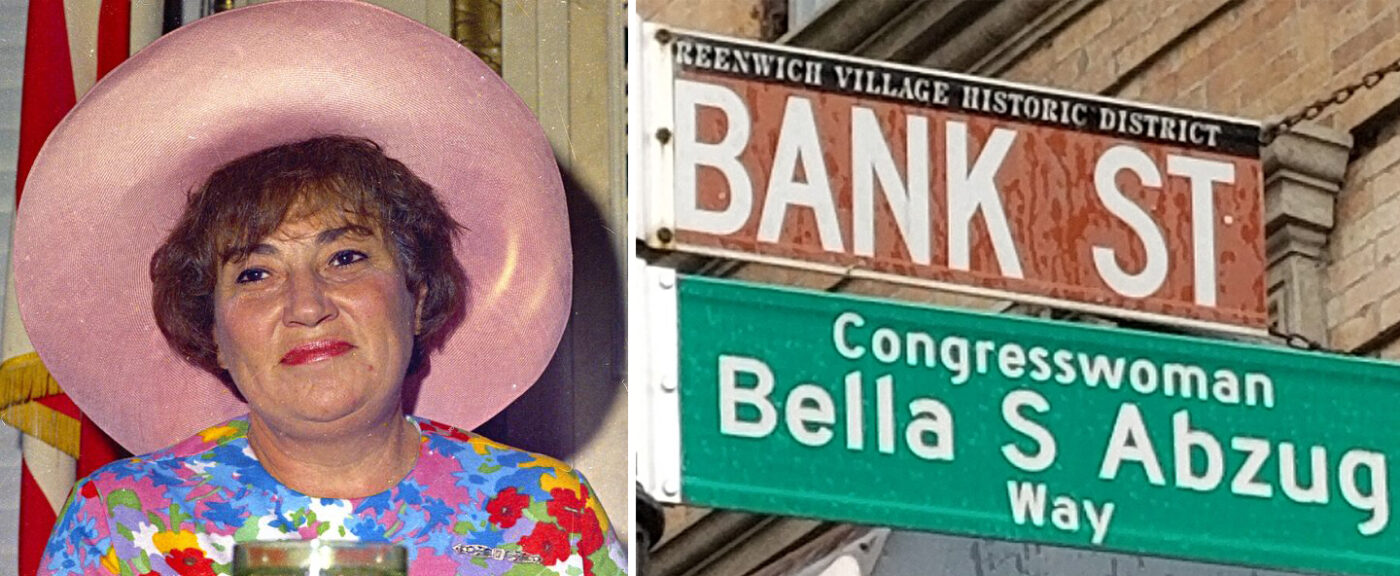
Born in the Bronx, Abzug attended Hunter College and Columbia Law School, then started a 25-year-long career in law, focusing on labor union workers and civil liberty work. In the 1960s, Abzug moved to 37 Bank Street (near West 4th Street) around the same time she worked with Shirley Chisholm, Gloria Steinem, and Betty Friedan to establish the National Women’s Political Caucus. She later moved to her long-time home at 2 Fifth Avenue.
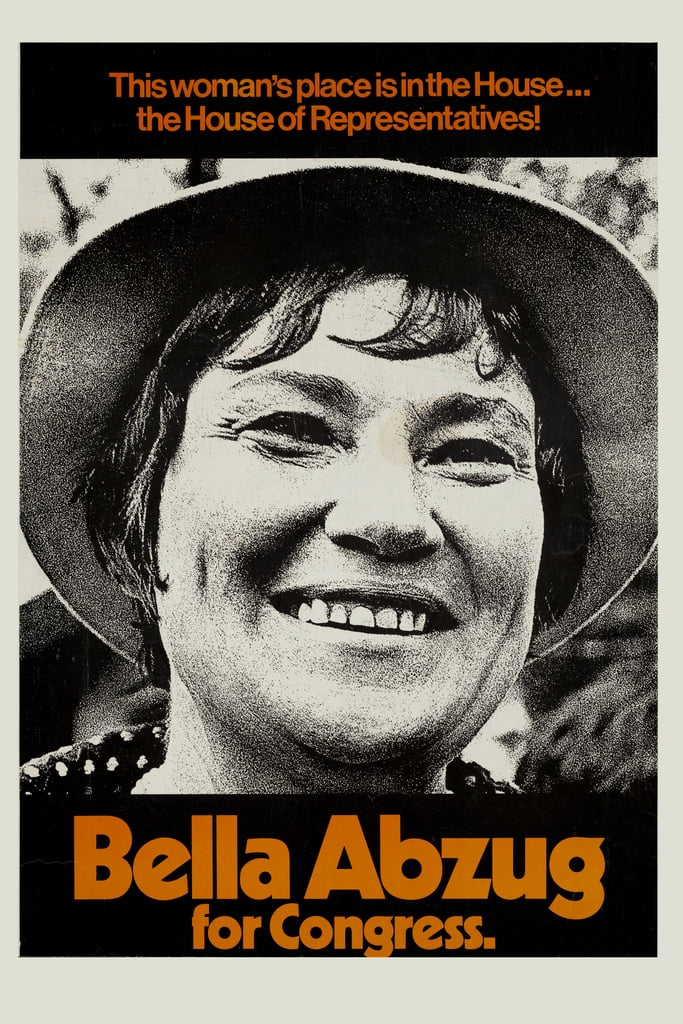
In 1970, Abzug ran for Congress to represent the Village and portions of Lower Manhattan and the West Side under the slogan “This woman’s place is in the House … the House of Representatives!” She defeated 14-year incumbent Leonard Farbstein in the then–19th Congressional District and went on to have a prestigious and sometimes controversial record in the House. Abzug was co-author of the Freedom of Information Act and the Water Pollution Act of 1972, and a sponsor of the Equal Rights Amendment. She also introduced the first federal bill to protect gay men and lesbians from discrimination, and became one of the first members of Congress to call for President Nixon’s impeachment. Abzug said she spent her days “figuring out how to beat the machine and knock the crap out of the political power structure.”
Abzug was memorialized with a street co-naming at the southeast corner of Bank Street and Greenwich Avenue in 2017, nearly two decades after her death. “She was a strong voice,” said then–Council Speaker Corey Johnson at the unveiling ceremony for Bella Abzug Way, “with a thick New York accent for those who needed her most, namely the poor and marginalized.”
Read more about Abzug’s career in Washington and the Village here and on our Civil Rights and Social Justice Map.
Sara Curry
A teacher in the late 19th and early 20th centuries, Sara Curry founded the Little Missionary’s Day Nursery in 1896. The oldest nonsectarian school in New York City, Little Missionary’s still provides affordable day care to children of all ethnic and religious backgrounds.
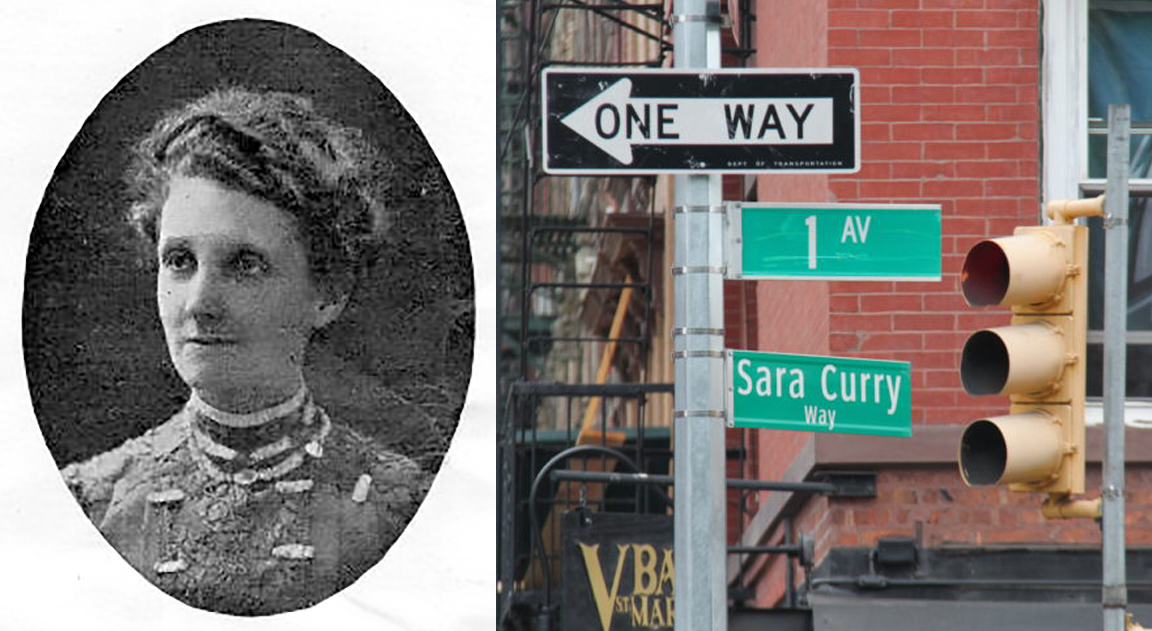
Born in 1863, Curry was given the nickname of the Little Missionary thanks to her diminutive stature. She arrived in the city from Utica in Upstate New York in 1896, and established a nursery in two rooms at 204 Avenue C to care for underprivileged children during the day as their parents went off to work. Two years later she moved the nursery to 365 East 10th Street, where her work garnered interest from both the press and wealthy philanthropists. With the attention of the former and financial help from the latter, she purchased the house at 93 St. Mark’s Place and grew the school even further. According to a 1908 Harper’s Weekly article, more than 28,000 children were received at the nursery in 1907, as well as 16,000 poor families visited and 10,000 sick persons nursed. All of these services were conducted with the aim to “restore dejected families to moral and physical health and teach them self-support and self-respect,” said the magazine.
Sara Curry Way was affixed to St. Marks Place between First Avenue and Avenue A in 2012. Read more about her legacy here.
Frieda Zames
Disability rights activist Frieda Zames played a key role in getting New York’s businesses, government agencies, and transportation boards to increase accessibility through the city. Born in 1932, Zames suffered from polio at an early age, and after several years in the hospital was forced to rely on crutches to pursue her teaching career at the New Jersey Institute of Technology, among other roles.
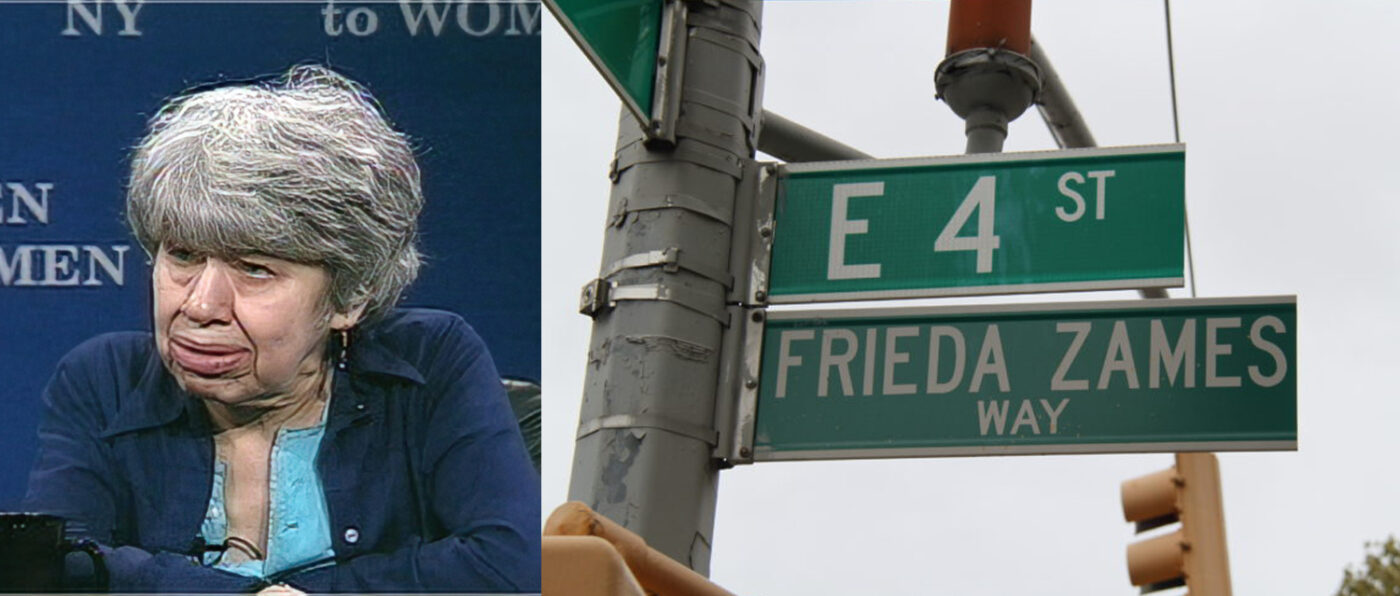
Zames’ activism began in the 1970s when she became heavily involved with the disability rights group Disabled in Action. Trading her crutches for a motorized scooter around that time, she was more easily able to attend the group’s actions. One of her first protests took place when she joined a group of paraplegics from Disabled in Action in surrounding an M14 bus on Third Street and Avenue A to advocate for wheelchair access to city buses. That campaign led to wheelchair lifts being installed in buses starting in 1981. Shortly after the American with Disabilities Act went into effect in 1990, she successfully sued the Empire State Building for accessibility and took part in a similar cause at NJIT. Focusing on civil disobedience, litigation, and advocacy literature to obtain full participation in public life for disabled people, Zames served several terms as president of Disabled in Action.
“Many of the victories in the disability civil rights movement we all now enjoy can be directly attributed to Frieda,” activists Anne and Sidney Emerman told The Indypendent in her 2005 obituary. “A petite woman, she was a giant in our midst, truly a national and local treasure.”
East 4th Street between 1st Avenue and Avenue A was named Frieda Zames Way in 2008.