
Japanese-American History in Greenwich Village and the East Village, Part I
The Asian-American story in the United States is often told through the lens of the West Coast or the bustling streets of Manhattan’s Chinatown. But the Asian-American history of Greenwich Village and the East Village is just as vital and noteworthy. Here, an impressive yet frequently overlooked roster of individuals and organizations played a pivotal role in our national story, particularly within the realms of civil rights and the arts.
While the first official Japanese diplomatic mission to the United States occurred in 1860, New York City maintained just a tiny Japanese community until the 1950s due to restrictions on immigration. Even following the change in immigration law, until recent decades, most Japanese people in New York City were not immigrants seeking to make permanent homes here, but international businessmen, diplomats, and their families. While Japanese immigrant and Japanese-American populations in New York City remain statistically small when compared to other immigrant groups, these communities have had a profound impact in the arts and cultural sector, especially within Greenwich Village, the East Village, and NoHo. The following are just some of the significant people, places, and institutions connected to Japanese-American heritage in these neighborhoods.
Japanese Introduction to NYC
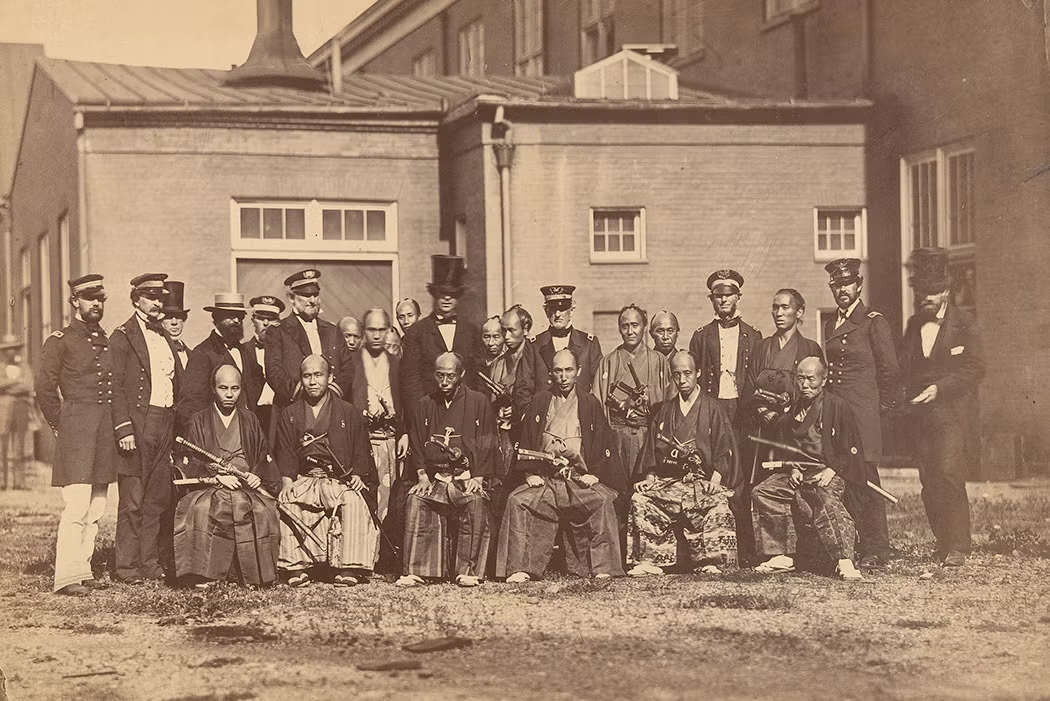
On June 16, 1860, a parade of Samurai took place on Broadway, starting downtown and ending at Union Square. Approximately 500,000 people attended the parade, about two-thirds of the city’s population at the time. Walt Whitman wrote a poem about the event, titled “A Broadway Pageant.” Published in his seminal work Leaves of Grass, he described the “swart-cheek’d two-sworded envoys” moving through the city. It was followed by an evening reception at the Metropolitan Hotel on Broadway and Prince Street (demolished 1895), where the group stayed for about two weeks.

Following the Meiji Restoration, the political event that restored imperial rule to Japan in 1868, the Japanese community in NYC started to grow. In 1876, six Japanese businessmen arrived on a ship called the Oceanic to establish trade companies and represent Japanese commercial interests. By 1900, the Japanese population in NYC had grown to about 1,000 people.
While the Chinese Exclusion Acts of 1882 restricted Japanese immigration to the United States, it was not officially prohibited. But due to a gentlemen’s agreement between the U.S. and Japanese governments, Japanese immigration remained low until it was officially prohibited by the National Origins Act of 1924. Following the attack on Pearl Harbor in 1941, the Japanese consulate and several Japanese businesses in New York City closed. While the full Japanese population was not mass-interned as on the West Coast, many community leaders were interned at Ellis Island. The internment of Japanese Americans formally ended in 1946, but it wasn’t until 1988 that President Ronald Reagan signed the Civil Liberties Act, officially apologizing for the “racial prejudice, war hysteria, and failure of political leadership” and offering reparations to those who had been incarcerated.
Isamu Noguchi Studio and Residence, 33 MacDougal Alley and 52 West 10th Street
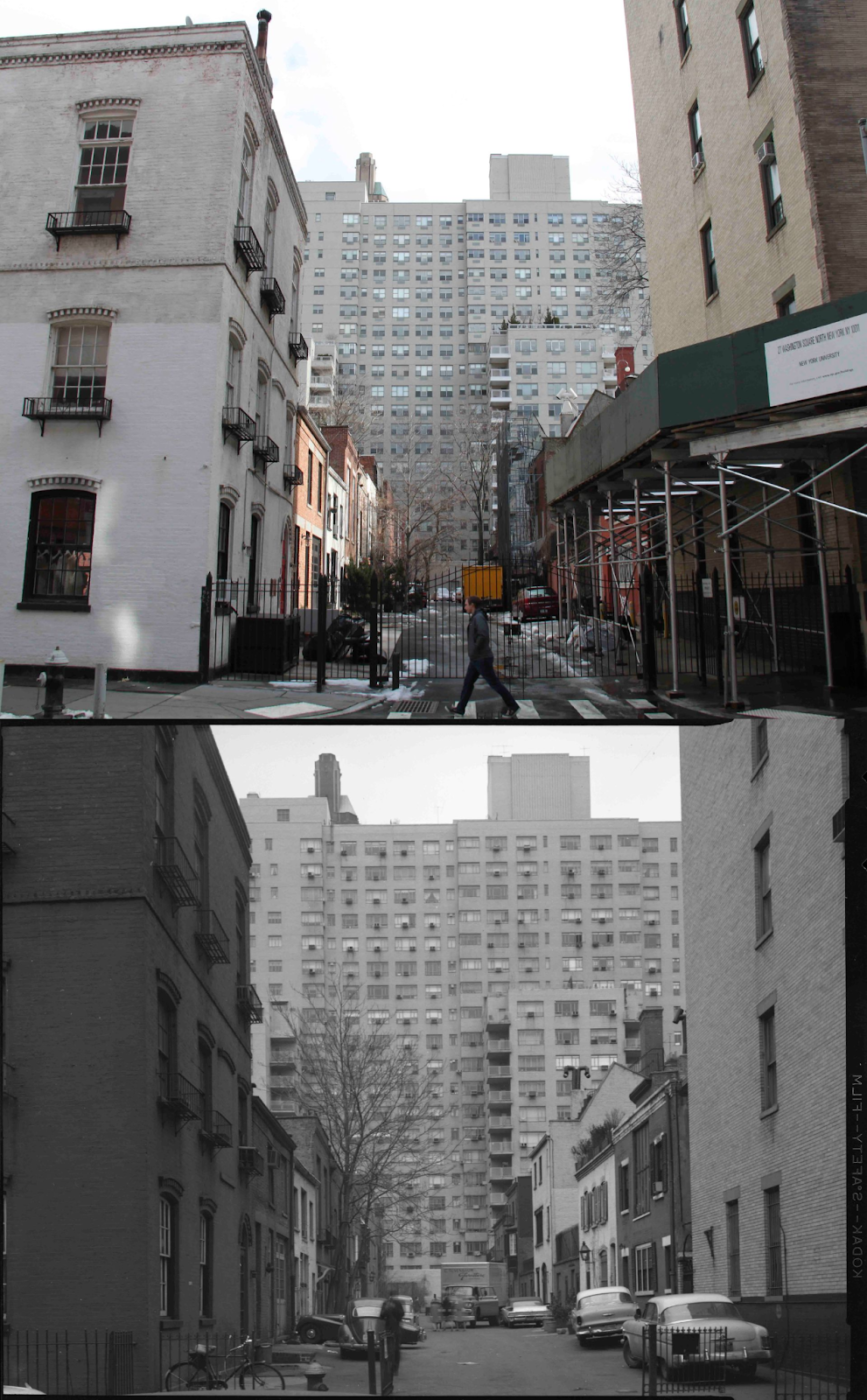
From 1942 until the late 1940s, Noguchi lived and worked at 33 MacDougal Alley, which was later demolished to make way for the high-rise apartment building at 2 Fifth Avenue. Many of the residences on MacDougal Alley were former stables, built beginning in 1833 and converted to artist studios in the early 20th century.
By the time of the attack on Pearl Harbor on December 7, 1941, Noguchi was already a well-known and accomplished sculptor. When anti-Japanese sentiment in the United States escalated following the attack, Noguchi formed “Nisei Writers and Artists Mobilization for Democracy” to speak out against the internment of Japanese-Americans, testifying at congressional hearings and lobbying government officials. Despite his and others’ efforts, over 100,000 Japanese-Americans living on the West Coast were sent to internment camps.
Noguchi reached out to John Collier, head of the Bureau of Indian Affairs, who persuaded him to travel to the Poston Internment Camp located on an Indian Reservation in Arizona to promote art in the community. He arrived in May 1942, becoming its only voluntary internee. He found the conditions unbearable, including the extreme desert heat. Although Noguchi worked on many projects to increase the quality of life for internees at Poston, he found the authorities had no intention of implementing them. He was viewed with suspicion by both internees, who thought him a spy and an outsider, and the authorities, to whom he was a troublesome interloper. Intelligence officers labeled him as a “suspicious person” due to his involvement in activism against internment. After he left the camp, Noguchi received a deportation order. The FBI accused him of espionage and launched a full investigation, which ended only through the intervention of the ACLU. Noguchi would later retell his experience in the documentary series, “The World at War.”
On April 16, 2026, Village Preservation installed a historic plaque honoring Noguchi at his former home and studio at 52 West 10th Street.
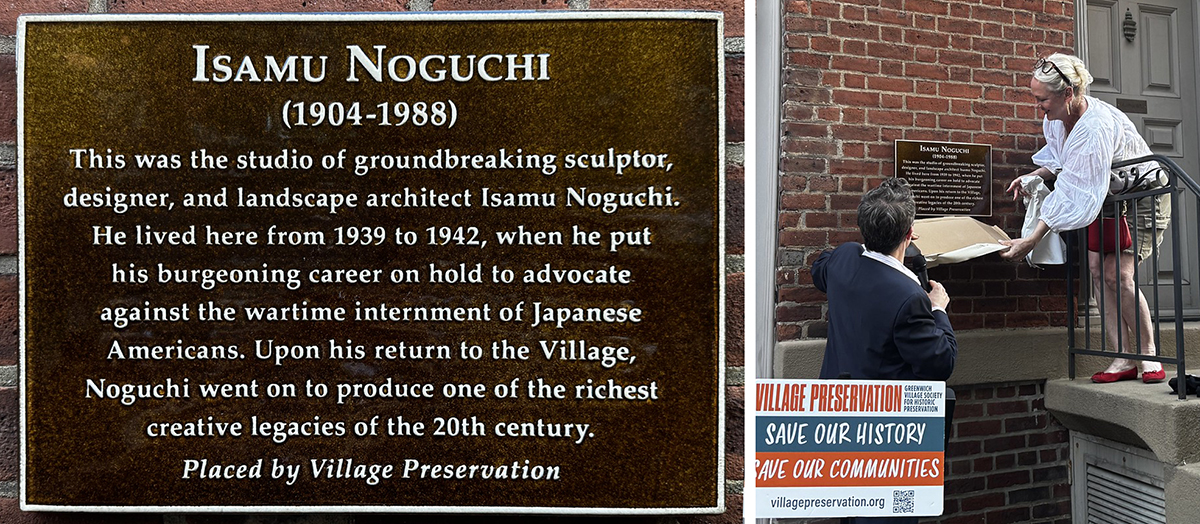
Watch the video of the plaque unveiling ceremony here, featuring speakers from the Isamu Noguchi Foundation and Garden Museum.
Miné Okubo, 17 East 9th Street
Miné Okubo (June 27, 1912 – February 10, 2001) was a Japanese-American artist born in Riverside, California. She is best known for her 1946 book Citizen 13660, in which she recounts her experience in a Japanese-American internment camp. It was one of the first widely-circulated personal accounts of the repression and indignities faced by over 100,000 Japanese-Americans during World War II, and is considered to this day to be one of the most affecting pieces about that chapter in American history.
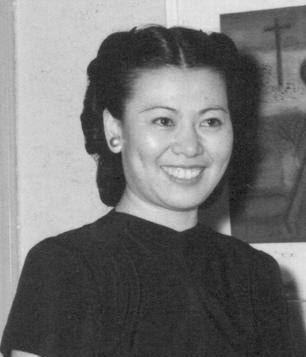
Okubo received her Master’s of Fine Arts from UC Berkeley in 1938 and spent two years traveling in France and Italy developing her skills as an artist. The outbreak of war in Europe forced her to return to the United States, at which point she began working for the Works Progress Administration’s art programs in San Francisco. Following the attack on Pearl Harbor, President Roosevelt’s Executive Order 9066 called for the imprisonment of thousands of Japanese immigrants and Japanese-Americans living on the West Coast. Okubo and her brother, Toku, were sent to the internment camp Tanforan, which had been created as a “temporary assembly center” on a horse racing track in San Bruno, California. They were later relocated to the Topaz Camp in Utah, where they lived in harsh conditions with about nine thousand other Japanese-Americans. Okubo documented her experience at the camp in her sketchbook, recording images of the humiliation and everyday struggle of internment.
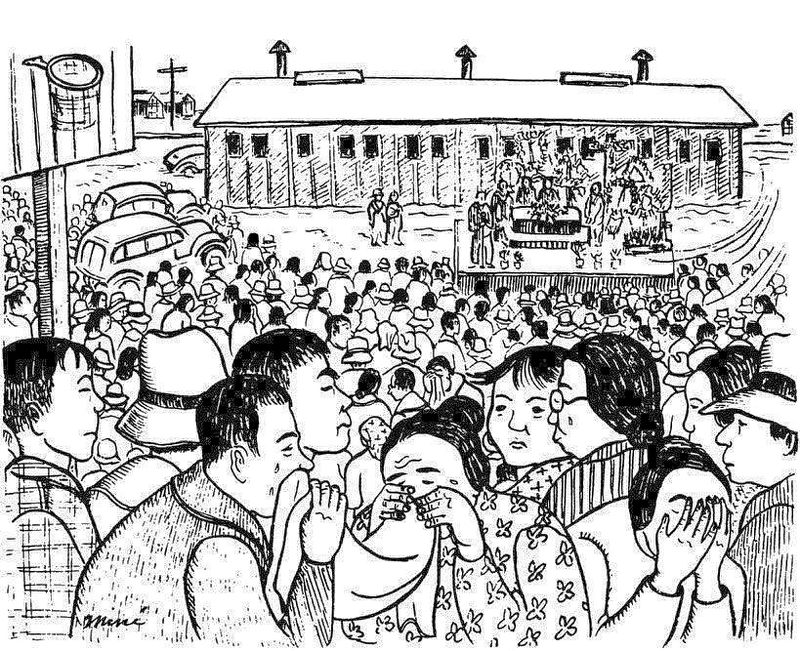
In time, Fortune magazine learned of her talent and offered her assignments. When the War Relocation Authority began allowing people to leave the camps and relocate to areas away from the Pacific Coast, Miné took the opportunity to move to New York City, where Fortune was located. Upon her arrival, she moved to 17 East 9th Street. It was here that she completed her work on Citizen 13660, named for the number assigned to her family unit, which contains more than 200 pen-and-ink sketches. Though she eventually moved into another apartment, she lived in New York for the rest of her life. Citizen 13660 is considered a classic of American literature and a forerunner of the graphic novel and memoir.
Yayoi Kusama, 70 East 12th Street
Yayoi Kasuma, born on March 22, 1929, is the world’s top-selling female visual artist.
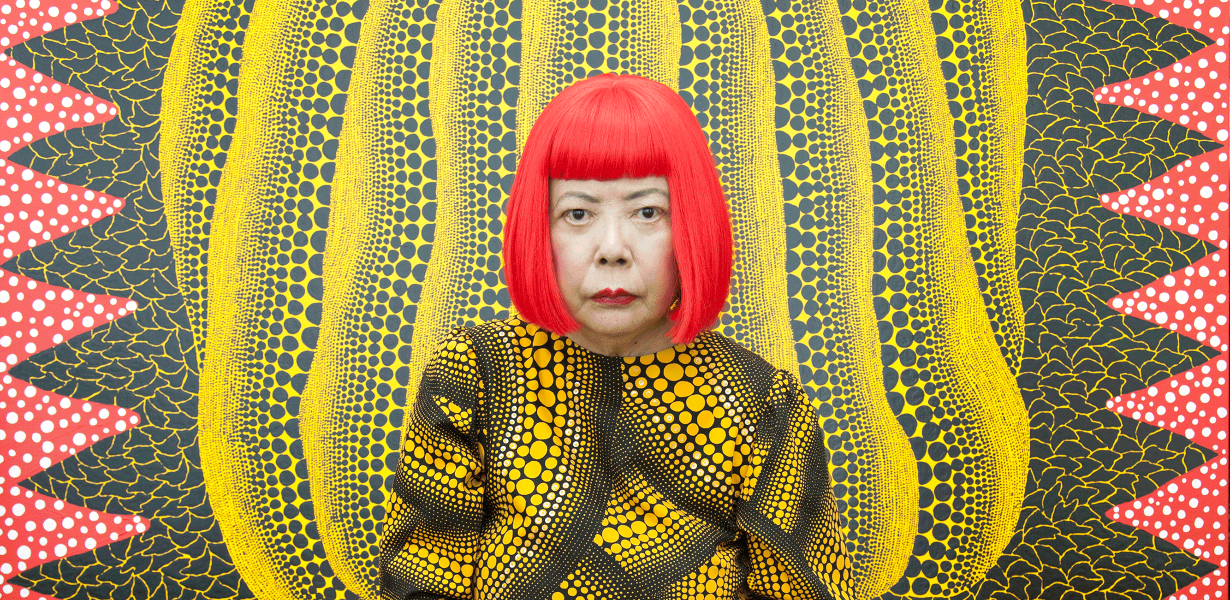
Kusama grew up on her family’s plant nursery and seed farm in Matsumoto City, Nagano Prefecture. She began experiencing hallucinations when she was ten years old — flashes of light, auras, or dense fields of dots. She began drawing around the same time, including sketches of pumpkins, which would later become a signature of her work. Kusama’s mother forbade the young artist from painting or creating artwork of any kind, insisting that her daughter was destined to marry a rich man and become a housewife. Nevertheless, Kusama went on to study the traditional Japanese Nihonga painting style at Kyoto Municipal School of Arts and Crafts after graduating high school in 1948. She soon grew frustrated with the style, however, and began creating work in the style of the European and American avant-garde. After success in Matsumoto and Tokyo galleries, she moved to the United States in 1957.
After a year in Seattle, Kusama moved to 70 East 12th Street in 1958 following encouraging correspondence from fellow artist Georgia O’Keeffe. She found life in New York to be artistically enriching, but much more trying than her time in Seattle. As a Japanese woman living in a major city after World War II, Kusama faced more hardship than many of her white, male peers. She often painted at night without heat and resorted to eating from restaurant dumpsters. Despite these trials, Kusama soon found acclaim. In 1959, she debuted at Brata, a gallery at 89 East 10th Street run by and for artists. It was there she debuted her Infinity Nets which were lauded for their hypnotic allure by critics, artists, and collectors.
Kusama soon became a central figure in the downtown New York avant-garde arts scene. She frequently staged exhibitions, including at the 1961 Whitney Annual at the Whitney Museum of American Art. However, Kusama was regularly hospitalized due to overwork, spurring a concerned Georgia O’Keeffe to convince her own dealer to purchase works to help Kusama stave off financial hardship.
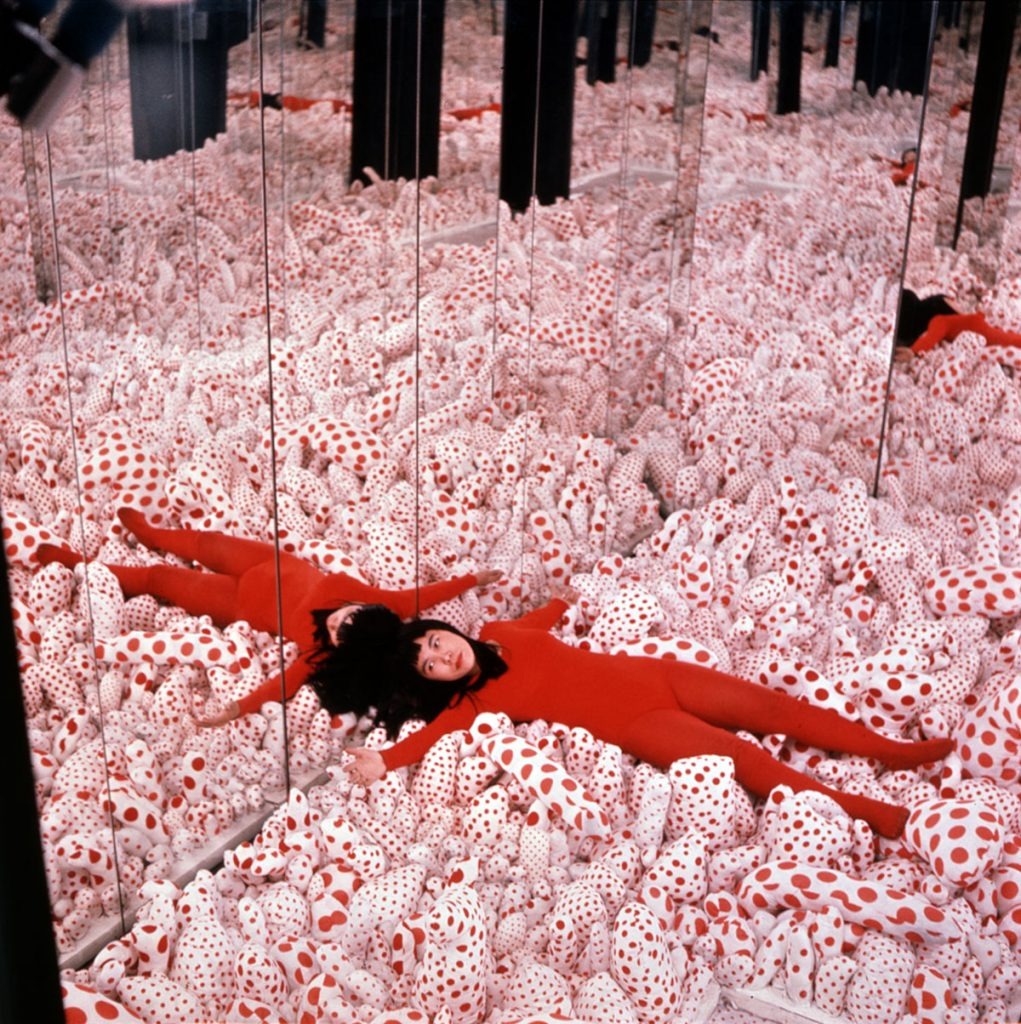
Her immersive work exploded in 1965 when she opened her first Infinity Mirror Room, Phalli’s Field. Kusama affixed thousands of fabric spotted tubers to the floor and furniture, echoing her previous Accumulations sculptures. She then covered the room’s four walls in mirrors, creating an infinite reflection so that one felt they were standing in an endless field of spotted tubers. This whimsical, surreal, and immersive installation became a signature style for Kusama, whose own visions seemed to be brought to life to be shared by her audiences.
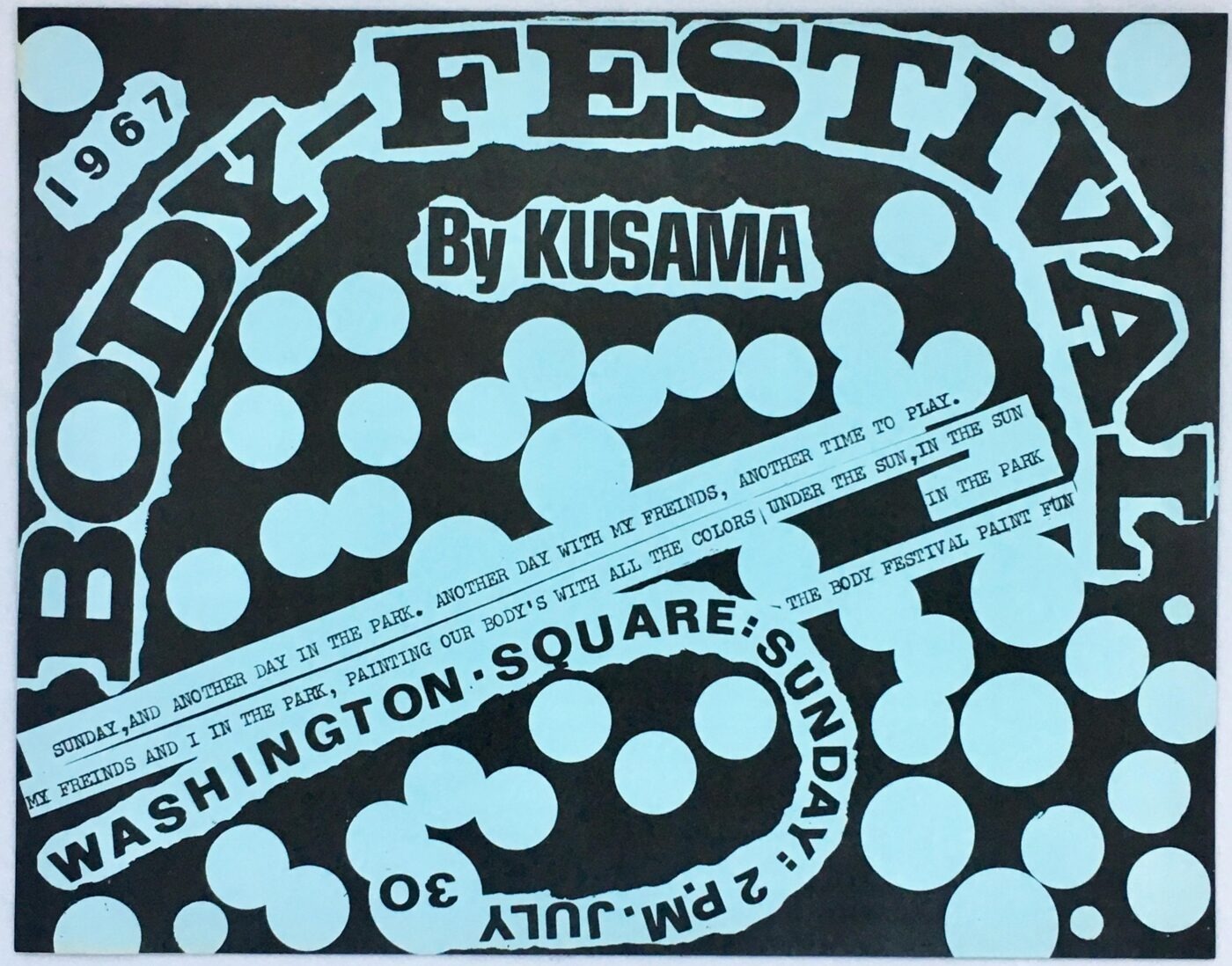
Kusama also made headlines for her public nudist gatherings in the late 1960s, reveling in the counterculture and anti-war sentiment that was sweeping the nation. In 1967 she invited New Yorkers to her “Body Festival” in Washington Square Park where participants would strip, be covered by Kusama in her signature painted polka dots, and “play” in the sun. The “High Priestess of Polka Dots” also presided over a 1968 gay wedding at the Church of Self-obliteration at 33 Walker Street. That same year, she performed alongside Fleetwood Mac at the Fillmore East.
Despite these successes, Kusama continued to be plagued by ill health and increasing paranoia. She believed her male peers, including Andy Warhol, Claes Oldenberg, and Lucas Samara were stealing her work while receiving far greater attention for it. She took to covering the windows of her gallery to prevent outsiders from looking in. This deterioration, combined with the rejection of her work by her family and Japanese community, led Kusama to attempt suicide.
Kusama returned to Japan in 1973 following her recovery. The country received her with little sympathy, however, viewing her bold work as distasteful and shameful. She became so depressed she was unable to work and made another suicide attempt. Thankfully, in 1977 Kusama encountered a doctor who used art therapy to treat mental illness in a hospital setting. She checked herself in and eventually took up permanent residence in the hospital by choice. Her studio, where she has continued to produce work since the mid-1970s, is a short distance from the hospital in Tokyo.
These tumultuous developments forced Kusama to build her career back from the ground up. After a quiet period of recovery and reflection from the late 1970s, Kusama once again rose to stardom with her work at the Japanese pavilion at the Venice Biennale in 1993. She crafted a dazzling mirrored room filled with small pumpkin sculptures in which she resided in color-coordinated magician’s attire, leading viewers through a shocking fantasy of color and brightness.
Since then, Kusama’s career has exploded. Her stylized pumpkins have become a Kusama signature, sprouting up to decorate landscapes around the world. Her works are instantly recognizable, cementing her as one of the most successful and iconic artists of her time.
Most of these entries, and 200 more just like it, are part of our Civil Rights & Social Justice Map. Explore this map covering not only Asian American but Black, Hispanic, LGBTQ+, and women’s civil rights history, among others.