
Randy Wicker’s Village: Mapping a Legacy
Randy Wicker is considered one of the most influential and impactful LGBTQ+ activists of both the pre- and post-Stonewall eras.
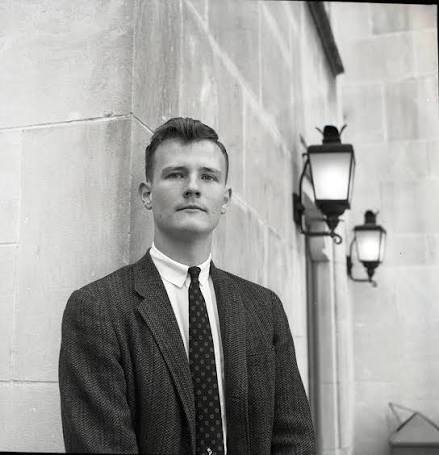
Born February 3, 1938, in Plainfield, New Jersey, as Charles Gervin Hayden, Jr., Wicker grew up with his grandparents in Florida. His first encounter with New York did not come until his college years. In 1958, while studying at the University of Texas, Wicker spent a summer in New York working with the NYC chapter of the Mattachine Society of New York (MSNY), one of the earliest and most influential gay rights organizations.
In the years after World War II, activism for LGBTQ+ rights was rare, usually quiet, and in most cases almost entirely isolated. With the 1969 Stonewall riots that it gained greater prominence, but was still considered a fringe movement for a very long time. Before Stonewall, there was the homophile movement, a fractured and scattered movement for gay and lesbian rights that arose following World War II — an era that was particularly hostile to LGBTQ+ people. Many cite the founding of the Mattachine Society in 1950 as the movement’s start.
By the late 1950s, Wicker’s involvement with the Mattachine Society and the broader homophile movement deepened. And, at his father’s urging, he changed his name from Charles Gervin Hayden Jr. so that his public activism for this highly stigmatized cause — connections to which could lead to loss of employment, home, violence, institutionalization, imprisonment, blackmail, or worse — would not lead back to his family.
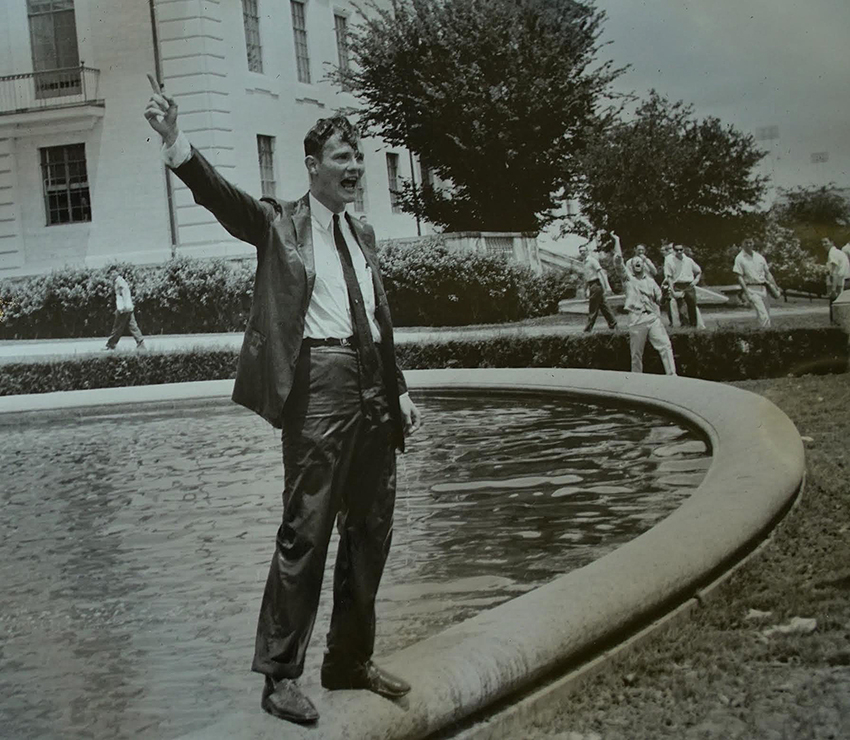
After graduating from the University of Texas, Wicker made the move to New York and continued working for the Mattachine Society. In 1962, he founded the Homosexual League of New York, which allowed him to take a more militant posture than the more conservative and incrementalist Mattachine Society. At the same time, anti-gay sentiment remained deeply entrenched. On one WBAI broadcast, a panel of psychiatrists defended the then-prevailing belief within their profession that homosexuality was a mental illness. Outraged, Wicker persuaded the station manager to allow him and several other gay men to go on air to speak about their sexuality. This 90-minute broadcast in July 1962 was covered by several mainstream media outlets and received significant publicity, and is believed to be the first such radio program in the United States that allowed gay people to speak for themselves and advocate for an end to discrimination against them.
Following the radio broadcast, Wicker became a spokesperson for the growing movement. He was the first openly gay person to appear on an East Coast television show after being on The Les Crane Show; then, later that year on September 19th, Wicker staged the first public demonstration for gay rights at the New York City U.S. Army Induction Center in Lower Manhattan, protesting the military’s treatment of gay people and the policy of releasing gay men’s draft records to current and potential employers.
While Wicker famously did not live in our neighborhood (he instead opted for a comfortable apartment across the Hudson River in Hoboken), his ties to the Village are plentiful. Today, with the help of our Civil Rights and Social Justice Map, we are looking at Randy Wicker’s journey through our neighborhood and recognizing his incredible impact.
Cooper Union

Cooper Union is one of the most historic and important sites in New York City’s history. The building has seen Abraham Lincoln’s speech that launched his presidential campaign, the Shirtwaist Strike of 1909, and, of course, Village Preservation’s annual awards and meeting. Since its opening in 1859, the Great Hall has served as a place of public gathering to address, confront, or engage some of the most pressing social, political, and cultural issues of the day.
On December 2, 1964, gay rights activist Randy Wicker and four others – including Kay Tobin & probably Craig Rodwell – staged a picket at the front entrance of the Great Hall, protesting a talk conducted by Dr. Paul R. Dince titled “Homosexuality, A Disease.” Wicker and two other gay men and one lesbian stood at the entrances to the Great Hall, handing out homophile literature and wearing signs requesting rebuttal time at the lecture. Wicker challenged Dince’s theories from the audience via a microphone and was met with applause. This protest, along with the one at the New York City U.S. Army Induction Center, has come to be known as the first public demonstrations for gay rights in the United States.
Julius’ Bar

Located at 159 West 10th Street, Julius’ Bar is one of New York’s oldest continuously operating gay bars. Originally established in 1867, the bar was attracting a gay clientele by the 1950s.
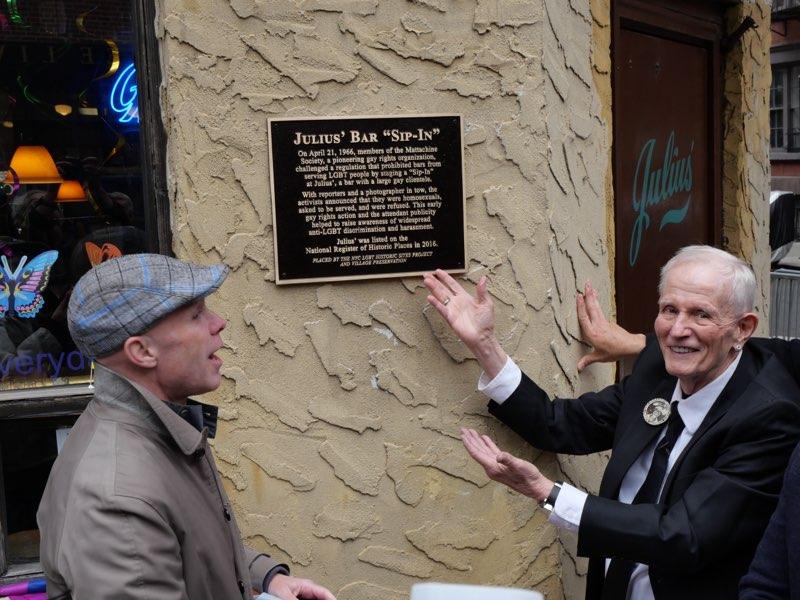
Even still, LGBTQ+ patrons faced widespread discrimination, often being criminalized for existing in public spaces. Inspired by the lunch-counter sit-ins that civil rights activists staged across the South, Randy Wicker and other members of the MSNY organized a sip-in at Julius’ Bar. And on April 21, 1966, they did just that, demanding that they be served as customers even if they openly identified as “homosexuals.” The action helped lead to the dismantling of discriminatory rules regarding LGBTQ+ people and gathering spaces three years before the nearby Stonewall Riots.

In April 2022, Village Preservation honored the site and its significance with a plaque, which Randy Wicker also attended.
28 St. Mark’s Place & 506 Hudson Street
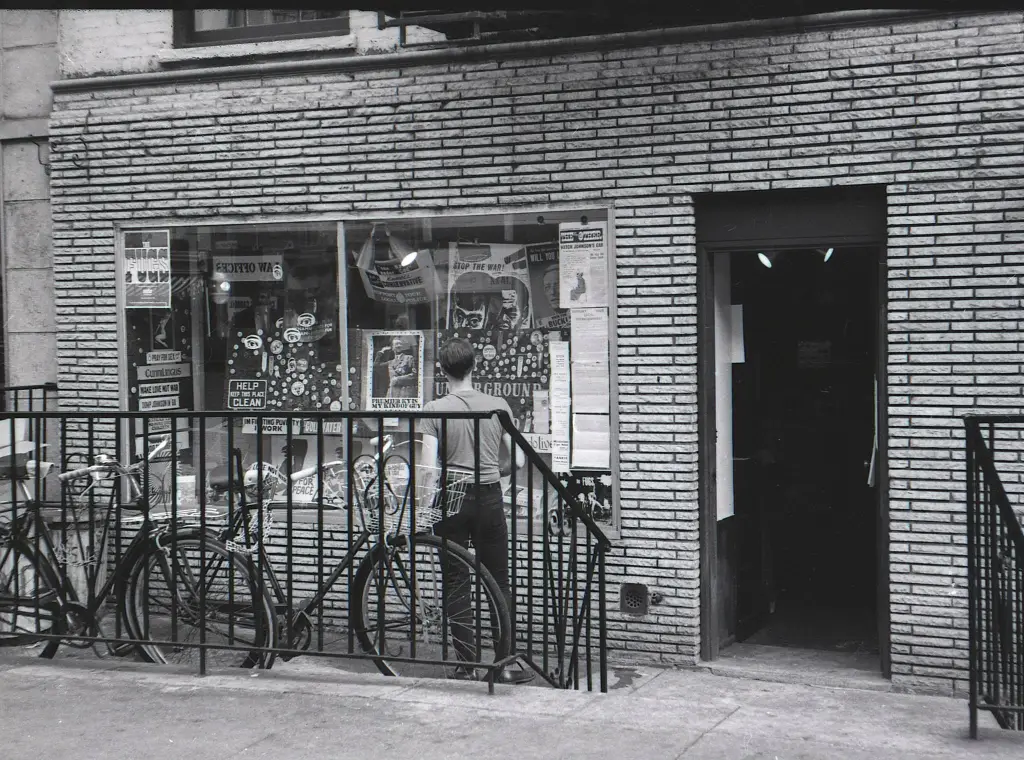
A year later, Wicker found himself owning and operating the head shop Underground Uplift Unlimited (UUU) at 28 St. Mark’s Place in the East Village. Known for its iconic posters and buttons that read “Make Love, Not War” and “More Deviation, Less Population,” the store reflected Wicker’s activist roots. UUU became the largest seller of protest pins in the country, selling hundreds of political, social, and Vietnam War protest pins for 25 cents each, which helped fund Wicker’s activist work.
In 1974, with his partner David Combs, he opened Uplift Lighting Corp., an antique/lighting store at 506 Hudson Street. Combs passed away from AIDS in 1990, and Wicker continued to operate the store until his retirement in 2003.
Randy Wicker helped lay the groundwork for the LGBTQ+ rights movement. His story is deeply intertwined with the history of our neighborhoods, where many of the movement’s earliest and most consequential actions unfolded. Explore these sites and more on Village Preservation’s Civil Rights and Social Justice Map.