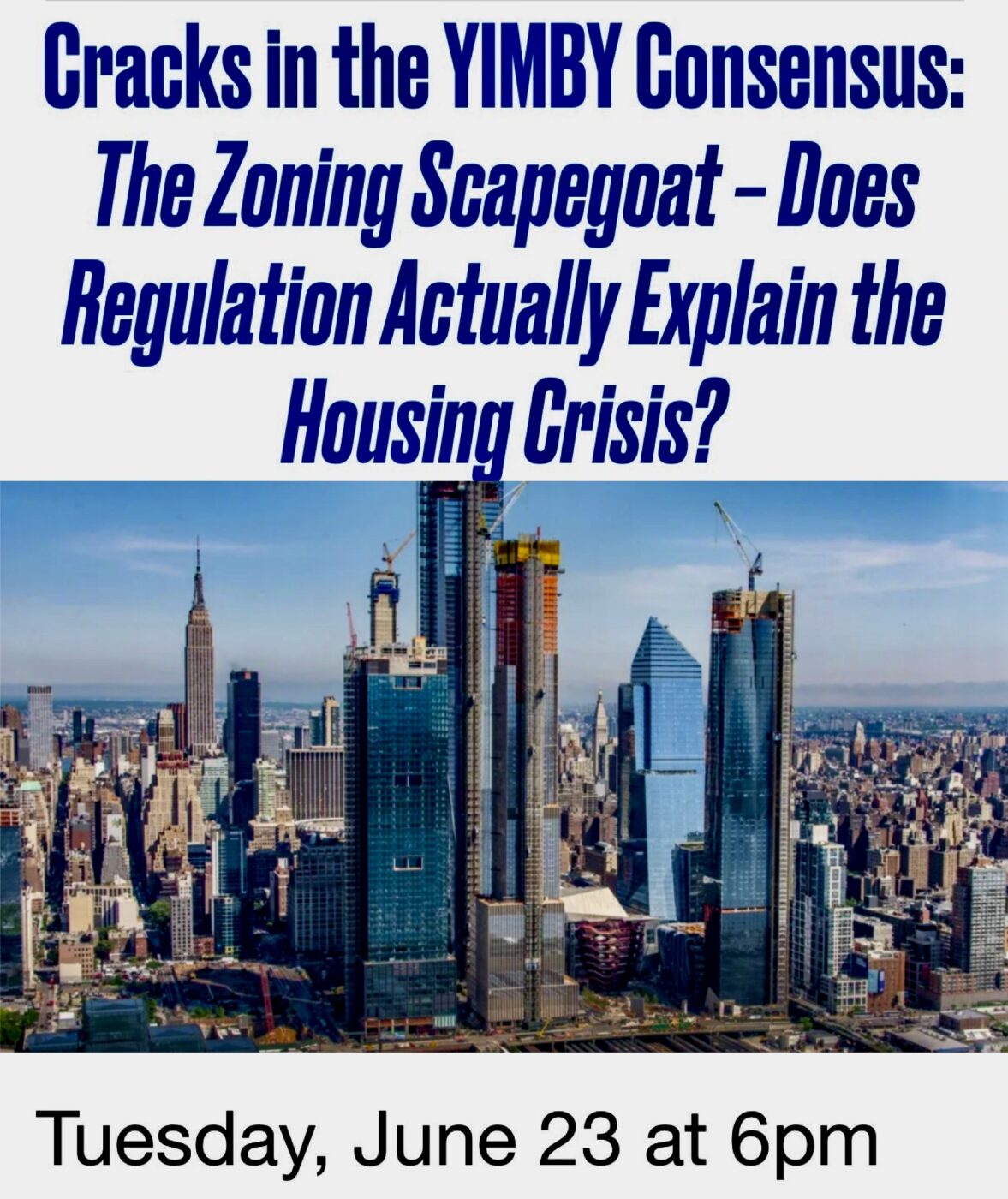
Cracks in the YIMBY Consensus, Part 1 (looking ahead to Part 2)

Affordable housing advocates have struggled to get any policy perspectives beyond the deregulation narrative that has come to dominate coverage of the affordable housing crisis. This deregulatory approach currently stealing oxygen from any other discussions about how to address the issue is hardly new. But it has reemerged with a new label (YIMBY) and a new ostensible rationalization (social equity), even if it rests on several predictable assumptions: 1) that the affordability crisis stems from a housing shortage; 2) that the regulation of housing development is to blame for this shortage; and 3) that its deregulation will allow the market to respond to the shortage with a construction surge that will lower housing prices.
Relentless repetition has created the impression that a consensus has formed around these arguments. But in fact, a wide range of housing research calls each of them into question. In recent years, we have offered reviews of this research (here, here, here, and here), issued reports challenging the YIMBY narrative, and done a number of programs with researchers whose work does likewise (here and here). More recently, we decided to launch a discussion series entitled Cracks in the YIMBY Consensus with the goal of bringing attention to various types of empirical evidence that disputes both the efficacy of deregulation in tackling the affordability crisis and the assumptions behind this approach.
Our first installment, Why Can’t We Upzone our Way Out of the Affordability Crisis?, featured Alan Mallach, housing scholar and former director of housing and economic development in Trenton, New Jersey.
Mallach treated us to a stimulating discussion built around a set of arguments worth checking out in full. Briefly, these were.
- Housing development costs create a systemic gap between housing prices and the means of low-income households that cannot be bridged by market rate housing construction at whatever scale.
- If there has been a housing production shortfall in the region, it has not been in the city, but in the suburbs.
- Zoning is a technical tool for the purpose of protecting and enhancing a complex urban environment. If you’re using it to merely plop down units without regard to that complexity, then you’re misusing it.
- Upzonings increase the value of land and this negates the affordability benefit to the consumer. In addition, this increase renders financially infeasible development at densities with lower construction costs per square foot, making new construction more expensive and new housing prices higher than they would have otherwise been.
- Development often requires the demolition of NOAHs (i.e., naturally occurring affordable housing), which can undermine local affordability.
Mallach followed his arguments with a set of recommendations, which are themselves worth checking out in full. But here’s a preview:
- Be surgical and selective in your use of zoning changes and be mindful of their downsides.
- Prioritize the preservation of NOAHs.
- Reform zoning at a state level, in order to help promote an adequate level of housing development in the suburbs.
- Push for more housing subsidies at the state and federal levels, since these are indispensable to the development of housing within the means of the most cost-burdened households.
- Don’t overpromise!
Mallach’s presentation at our lead-off event stimulated a conversation that could have gone on for several programs, and we may indeed invite him back. But we are also ready to switch gears and examine at a broader scale the efficacy of upzonings in moderating housing prices. Our second installment in the Cracks in the YIMBY Consensus series will feature Federal Reserve economist John Mondragon, whose recent research finds that the differences in housing affordability across areas reflects differences in the growth and type of housing demand rather than differences regulatory housing supply constraints. We hope you can join us. Go here to register for this free event. It promises to be another fascinating discussion.