
The Historic Twins of Commerce Street
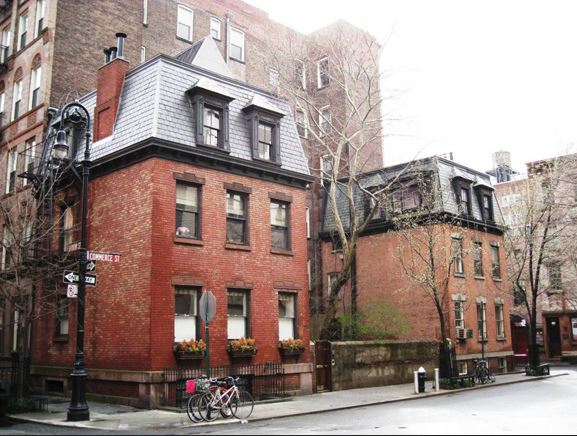
Originally built for a mere milkman, the two homes bookending the intersection of Barrow and Commerce Streets remain one of the most charming spots our neighborhood has to offer. Nestled between Bedford and Hudson Streets, 39 and 41 Commerce Street embody the quintessential Greenwich Village character. Colloquially called “the twins,” the nearly identical houses have become one of Greenwich Village’s most recognizable and beloved architectural pairings. With the help of the Greenwich Village Historic District Landmark Designation Report, we are exploring the history behind this very memorable duo.

An old wives’ tale suggests the two homes were built by a sea captain, in a futile attempt to reunite his feuding daughters who refused to share a home. So the story goes, the devoted father built identical houses side by side, connected by a garden, in hopes that living in such proximity would mend their fractured relationship. Though charming and a touch heartwarming, the truth behind the two houses is far less romantic, but incredibly fascinating nonetheless.
Rather than a seaman, the twins were built in 1831-32 for Peter Huyler, a milkman of Hackensack, New Jersey. Huyler never lived in the Village, instead renting out the homes as the neighborhood became an increasingly desirable place to settle.
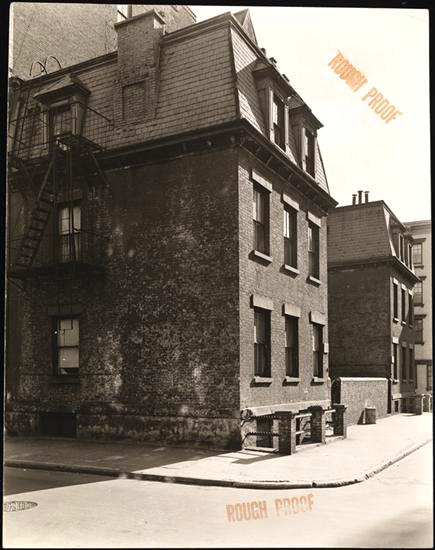
Greenwich Village saw a major population surge in the 1820s as an especially virulent yellow fever epidemic in 1822 plagued much of Manhattan. Consequently, many who had intended to remain in the area only temporarily chose to settle there permanently, quadrupling the neighborhood’s population between 1825 and 1840, and thereby spurring the development of markets and businesses. Like many other savvy businessmen, Huyler built the twins as a long-term investment. The first identifiable tenant of 41 Commerce Street was Peter Burdett, who moved there in 1842; for 39 Commerce Street, it was William Halsey, described in directories as a “captain,” who moved there in 1848.
The homes were originally just two and a half stories tall, joined by a shared garden. They are an interesting combination of late Federal style, in which they were originally built, as seen in the Flemish-bond brickwork and the fine paneled window lintels, uncovered only recently, and the French Second Empire style, in which they were later remade. That occurred in 1873, when the Huyler heirs hired architect Daniel T. Atwood to alter the roofs of 39 and 41 Commerce, expanding what had been a peaked roof with dormers (the 1/2 story) to a full third story beneath slate mansard roofs. It’s both thanks to luck and landmark protections (in place since the 1969 designation of the Greenwich Village Historic District that includes these houses) that the open space between them has not been built upon.
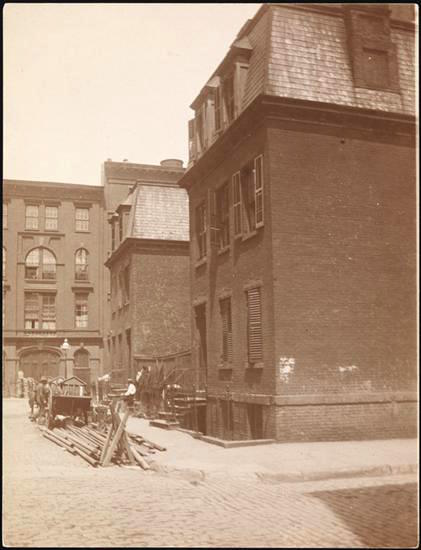
While the exterior of the homes has not changed much beyond the 1873 makeover, their interiors most certainly have. In the early 20th century, both buildings were converted into multi-family homes, each with four apartments. No. 39 Commerce remains a multi-family home, whereas no. 41 was converted back to its original state as a single private home. Behind these two low structures is the rear wall of the tall six-story apartment house which faces on Barrow Street.
Today, the twins on Commerce Street remain one of the most photographed spots in all our neighborhoods. While the legend of the sea captain and his stubborn daughters is quite entertaining, the true story of milkman Peter Huyler is just as intriguing. The twins came about as Greenwich Village was undergoing a transformation from a pastoral suburb into the urban neighborhood we know it as today.
And the twins are just one of countless architectural gems documented in our neighborhoods’ Landmark Designation Reports, as well as in our Greenwich Village Historic District Map and Tours, including its “Most Charming Sites” Tour, which includes the Twins among many other beloved and iconic sites in the neighborhood. Explore them all to uncover the rich histories behind even more of the history and irreplaceable architecture of Greenwich Village, the East Village, and NoHo.