
Aaron Burr’s Lasting Mark on the Village: A Land Sale, a Duel, and Revolutionary History
As the United States commemorates the 250th anniversary of the signing of the Declaration of Independence, Village Preservation has created a new Revolutionary War Map that brings the nation’s founding era to life in Greenwich Village, the East Village, and NoHo. While many associate the Revolutionary War with places like Lexington, Concord, or Valley Forge, our own neighborhoods have surprising and significant connections to the struggle for independence and the birth of the new republic. The map highlights dozens of sites connected to the Revolution and its aftermath, inviting visitors to discover the remarkable stories hidden along streets they may walk every day. One such story begins with Aaron Burr and an unassuming corner at Spring Street and Sixth Avenue.
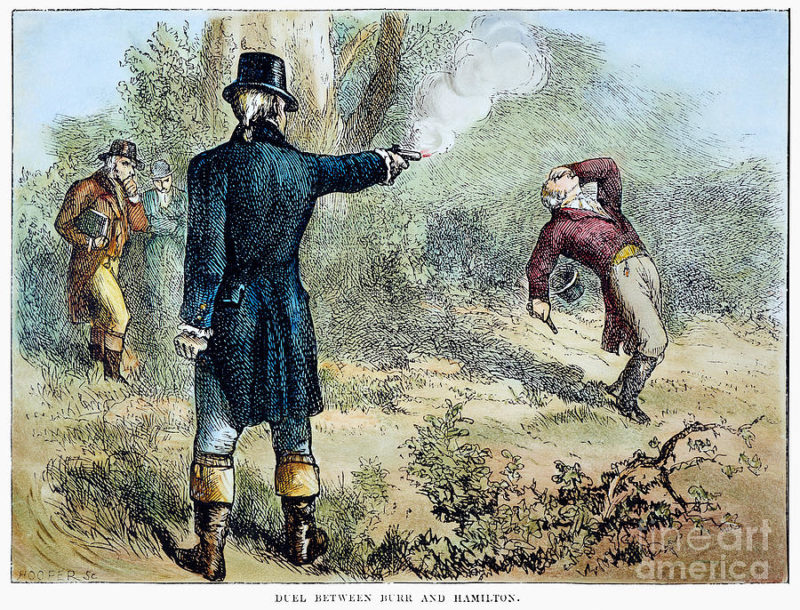
On July 16, 1804, just five days after his infamous duel with Alexander Hamilton in Weehawken, NJ, Aaron Burr made another consequential move. With murder charges looming in both New York and New Jersey, the sitting Vice President sold two plots of land near what is today the intersection of Spring Street and Sixth Avenue before fleeing the region.
The duel forever cemented Burr’s place in American history, but the land he sold tells another fascinating story, one rooted in the history of Greenwich Village and the evolution of New York City.
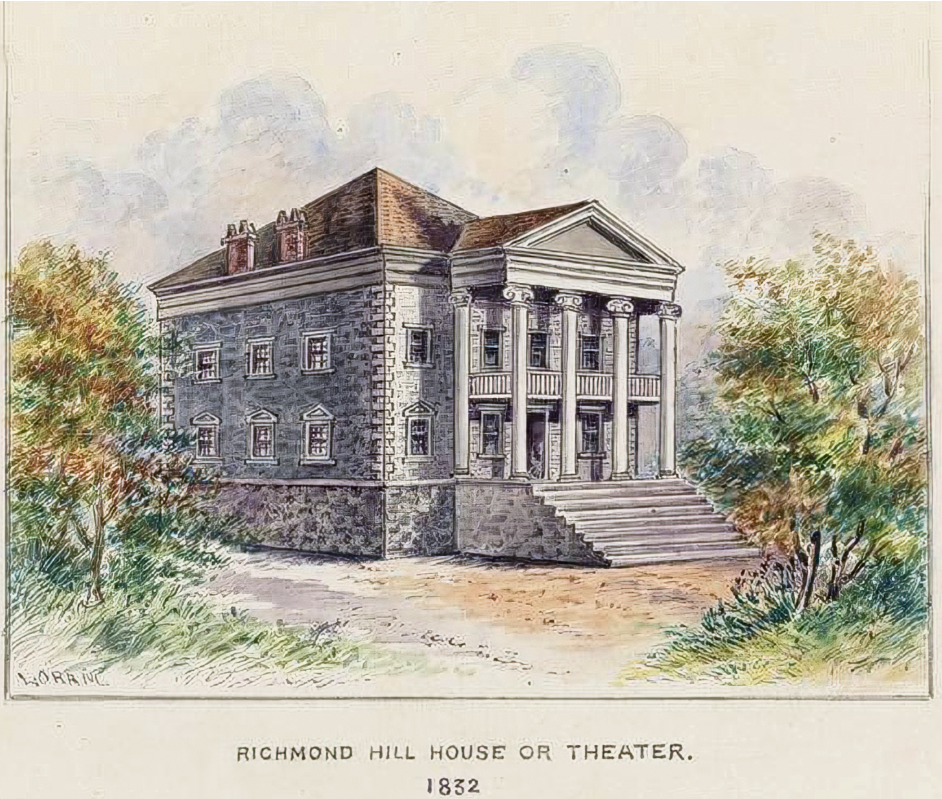
At the turn of the nineteenth century, the area around Spring Street looked nothing like it does today. It was part of the former Bayard estate, a vast tract of farmland that stretched from present-day Chinatown into what is now Greenwich Village. Burr had purchased a large portion of this land in the late 1790s, adding it to his nearby Richmond Hill estate, a sprawling country seat that occupied roughly 26 acres bounded by today’s Varick, Charlton, King, and MacDougal Streets.
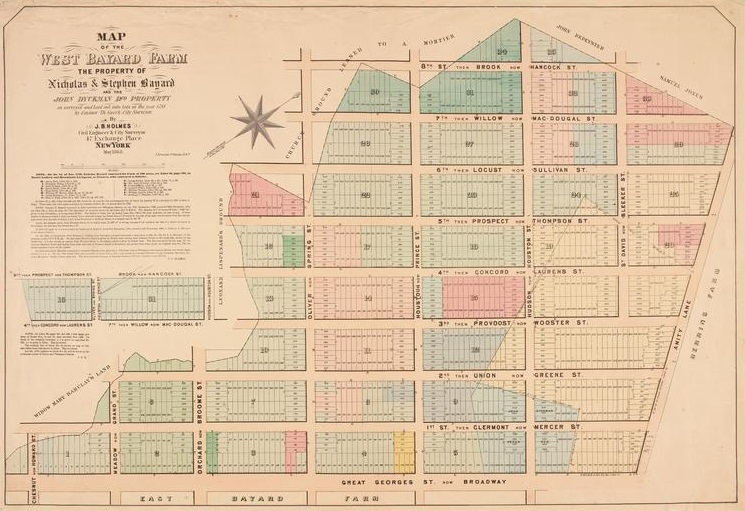
The two lots Burr sold occupied what became Block 490, just east of the future Sixth Avenue. Over the decades, modest Federal-era houses gave way to larger commercial buildings. Then, in the 1920s, the extension of Sixth Avenue south to Canal Street dramatically reshaped the neighborhood, demolishing hundreds of buildings, including nearly all traces of Burr’s former property. Today, only a tiny remnant of one of those original lots survives, tucked almost unnoticed along Spring Street.
It’s a reminder that history often survives in unexpected places.
From Revolutionary War Headquarters to Burr’s Estate
Aaron Burr’s connection to our neighborhoods extends well beyond the famous duel. Before Burr acquired Richmond Hill, the estate played an important role during the Revolutionary War. In 1776, as British forces advanced on New York, General George Washington used Richmond Hill as his headquarters while preparing the city’s defenses. The property later housed John and Abigail Adams during his Vice Presidency before Burr made it his home.
Aaron Burr’s land sale reminds us that even an ordinary street corner can hold extraordinary history. Long before Sixth Avenue cut through the neighborhood, before apartment buildings and storefronts lined Spring Street, this was part of the landscape where Revolutionary leaders lived, planned, governed, and, in Burr’s case, made decisions that echoed long after the smoke from a duel had cleared.
As America marks its 250th anniversary, there’s no better time to discover the Revolutionary history hiding in our own neighborhoods. Village Preservation’s Revolutionary War Map offers a new way to explore these places and uncover the stories that shaped both our city and our nation.
History isn’t confined to battlefields or monuments. Sometimes it’s found at the corner of Spring Street and Sixth Avenue.
I lived at 180 Sixth Avenue for eight years. Was it part of the property?