
General Knowledge Needed for Greenwich Village Streets
It’s fair to say that everyone knows the commander-in-chief of the Continental Army, first President of our nation, and “father of our country” George Washington, whose name shows up on a park, arch, several streets, and more in our neighborhoods. But did you know that Washington is not the only Revolutionary War general similarly commemorated with street namings in our neighborhood?
Village Preservation’s recently released map on the Revolutionary War in Greenwich Village, the East Village, and NoHo highlights the many figures who led our troops in the fight against the British Crown who are reflected in the names of our streets.
Lafayette Street
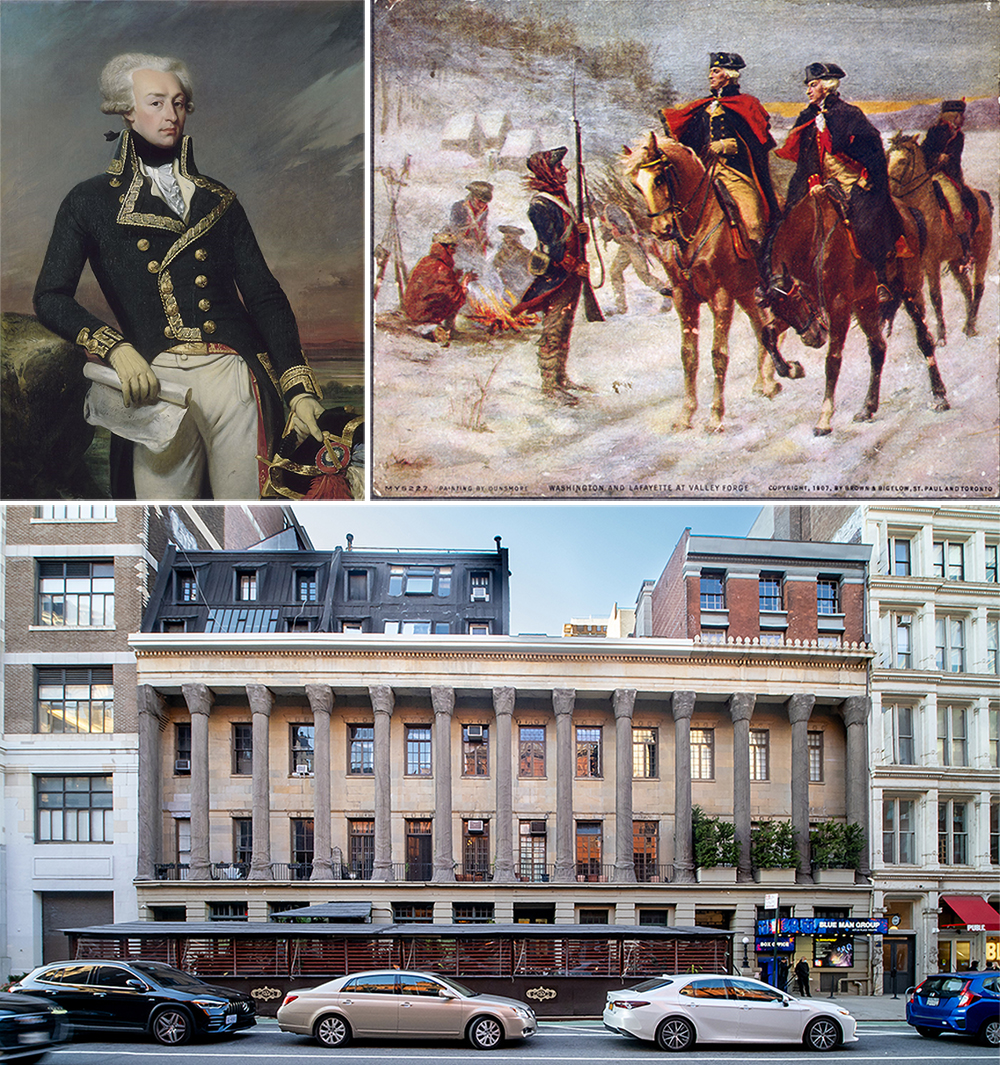
Marie-Joseph Paul Yves Roch Gilbert du Motier, better known as Marquis de Lafayette (1757-1834), was born into a wealthy land-owning family in south-central France. He quickly followed his family’s French military tradition, becoming an officer (a king’s musketeer) at just 13 years old. Convinced that the American revolutionary cause was a noble one, he traveled to the colonies seeking glory in the confrontation; he was named a major general at age 19 as a member of General Washington’s staff, culminating in his participation in the siege of Yorktown that marked the end of the war.
Following the war, Lafayette became famous in both the newly formed nation and his home country. His grand tour of the United States in 1824–25 is celebrated at numerous historic sites along the East Coast, including a plaque on P.S. 3 (490 Hudson Street) highlighting Lafayette’s visit to an earlier iteration of the school in 1824. Shortly thereafter, in 1826, a road stretching from Astor Place to present-day Great Jones Street was named Lafayette Place (in the early 20th century Lafayette Place was extended south to Lower Manhattan and renamed Lafayette Street).
Another local Lafayette honor can be found at La Grange Terrace/Colonnade Row at 428-434 Lafayette Street, a distinctive grouping of rowhouses completed in 1833 named after Lafayette’s estate in France, the Château de la Grange-Bléneau. Nine buildings were originally built as part of this distinctive two-story Corinthian colonnade of marble; only four remain, all of which are landmarked.
John Sullivan
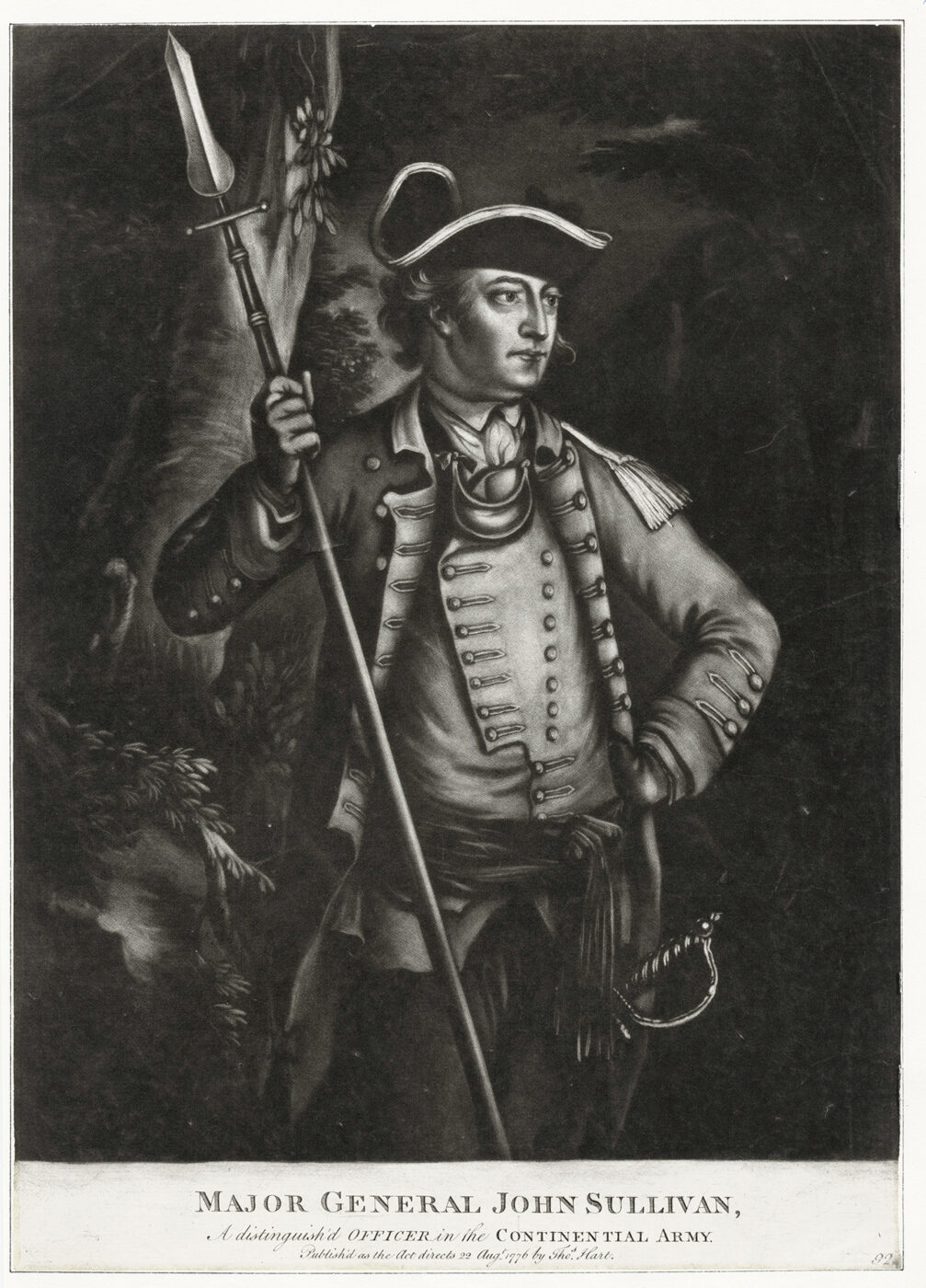
Major General John Sullivan (1740–95) was one of the Continental Army’s most important field commanders during the American Revolution. A delegate to both the First and Second Continental Congresses, Sullivan left Congress in 1775 to accept a commission as a brigadier general and was promoted to major general the following year. He fought in many pivotal campaigns, including the Siege of Boston, the New York effort, and the battles of Trenton and Princeton. He also led the 1779 Sullivan Expedition against the Haudenosaunee (Iroquois) nations allied with the British, a campaign ordered by George Washington that destroyed dozens of towns and remains highly controversial today because of its devastating impact on Native communities.
Four years after Sullivan’s death, New York City honored the Revolutionary general by renaming Locust Street as Sullivan Street in 1799. This and many other streets were renamed that year commemorating military leaders of the Revolution, including all the generals that follow.
Horatio Gates
General Horatio Gates (1727–1806) was one of the most celebrated American commanders of the Revolutionary War, though his military career was marked by both triumph and disappointment. A former British Army officer who joined the Continental Army in 1775, Gates served as adjutant general before assuming command of the Northern Department. His greatest achievement came in 1777, when his army forced British General John Burgoyne to surrender at the Battle of Saratoga. The American victory is widely regarded as the turning point of the Revolution because it persuaded France to enter the war as an ally. In recognition of the victory, the Continental Congress awarded Gates a gold medal. His later defeat at the Battle of Camden in 1780, however, severely damaged his reputation, and he never again held a major field command.
After the war, Gates settled in New York, purchasing the Rose Hill Farm near modern-day 23rd Street and Lexington Avenue, and was a respected public figure until his death in 1806.
Horatio Street in Manhattan commemorates General Gates, but unusually used his first name when the street was designated in 1799. (Gates Avenue in Brooklyn also honors the general, but uses the more standard naming convention.)
Nathaniel Greene
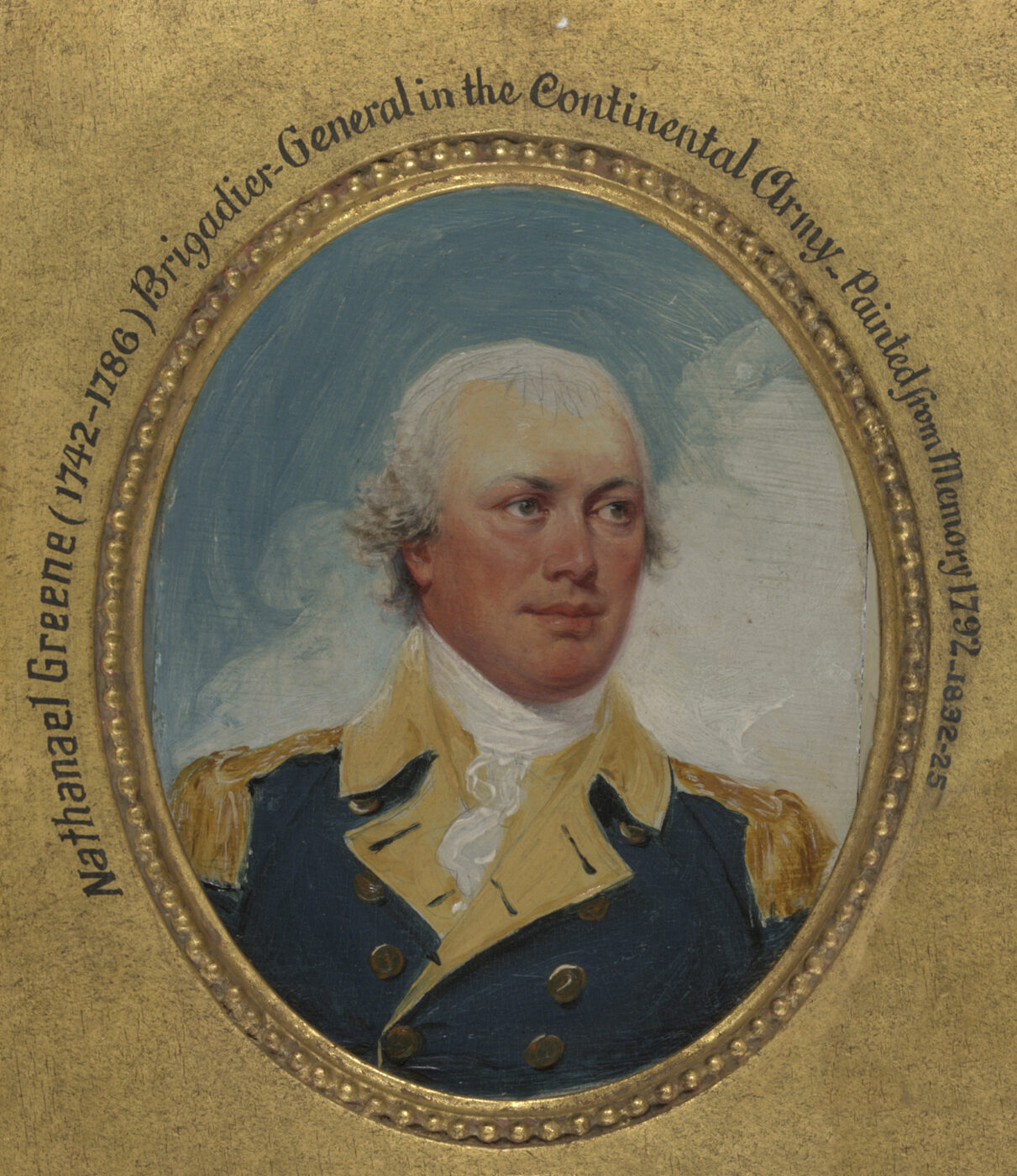
Major General Nathanael Greene (1742–86) is widely regarded as George Washington’s most gifted and dependable subordinate during the American Revolution. A self-taught military strategist from Rhode Island, Greene was appointed a brigadier general in 1775 and quickly became one of Washington’s most trusted commanders. He played key roles in the defense of New York, the victories at Trenton and Princeton, and the difficult winter at Valley Forge, where he later served as Quartermaster General and helped reorganize the Continental Army’s supply system. In 1780 Washington selected Greene to command the Southern Department, where he employed a brilliant strategy of maneuver and attrition against British General Charles Cornwallis. Although he lost several tactical engagements, including the Battle of Guilford Courthouse, Greene’s campaign steadily weakened British forces, contributing directly to Cornwallis’s march into Virginia and eventual surrender at Yorktown in 1781.
Historians consistently rank Greene among the Revolution’s most effective generals because of his leadership, strategic vision, and crucial role in securing American independence.
Alexander McDougall
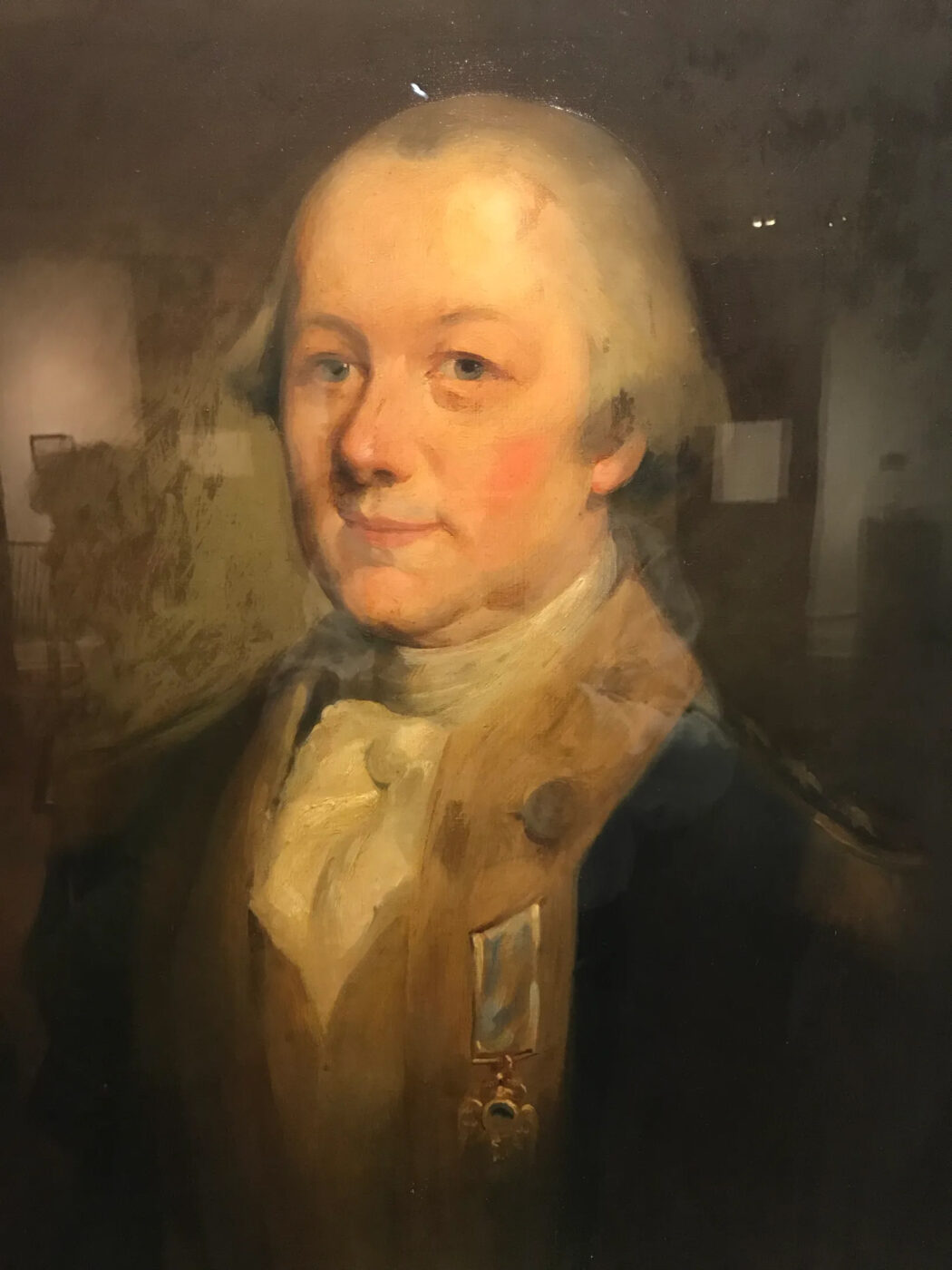
Major General Alexander McDougall (1732–86) was one of New York’s most prominent Revolutionary leaders and among the city’s earliest champions of American independence. Born on the Scottish island of Islay, McDougall immigrated to New York as a child and became a successful merchant and an outspoken critic of British rule. A leader of the Sons of Liberty, he was commissioned as a brigadier general in the Continental Army in 1776. Promoted to major general the following year, McDougall fought in the New York and Philadelphia campaigns, served under General Washington, and commanded the Hudson Highlands. In 1780, after Benedict Arnold’s treason was exposed, Washington appointed McDougall commander of West Point, entrusting him with one of the nation’s most strategically important military posts.
Following the war, McDougall served as a delegate to the Continental Congress and became the first president of the Bank of New York, helping shape both the new nation’s military and financial foundations.
MacDougal Street was laid out on land owned by the Bayard family (also featured in our map). Although his surname was traditionally spelled “McDougall,” the street adopted the simplified spelling “MacDougal.” Nearby, MacDougal Alley is a private mews extending east from MacDougal Street between West 8th Street and Washington Square North; created in 1833 to provide access to stables and carriage houses for private residences, it was renamed for the general 50 years later.
William Thompson
Brigadier General William Thompson (1736–1781) was one of the Continental Army’s earliest generals, though his Revolutionary War career was marked by both distinction and controversy.
An Irish-born veteran of the French and Indian War, Thompson commanded one of Pennsylvania’s first regiments of riflemen before the Continental Congress appointed him a brigadier general in 1776. He was assigned to reinforce the American invasion of Canada, where he led an ambitious but poorly coordinated attack against British forces at the Battle of Trois-Rivières on June 8, 1776. The assault ended in a costly defeat, and Thompson was captured, making him one of the highest-ranking American officers taken prisoner during the Revolution. Thompson remained a prisoner until exchanged in 1780, but he never again held an important field command before his death a few months after his release.
Despite his mixed military record, Thompson’s early service earned him a place among the Revolutionary officers commemorated in Manhattan’s street plan. Thompson also received another local honor when Thompson Playground opened on his namesake street between Spring and Prince Streets; it was renamed Vesuvio Playground in the 1990s for the nearby popular bakery that was owned by community leader Tony Dapolito.
Explore dozens of Revolutionary War-related sites on our map here, and our many other maps covering local history and culture here.
A little footnote about Gen. Horatio Gates is that he was an early congregant and pew-holder at St. Mark’s Church in-the-Bowery. It would have made for interesting conversation at St. Mark’s in those days among the Patriots and former Loyalists who began St. Mark’s and worshipped together, just years since the war ended.