
The Historic Synagogues of Our Neighborhood
In August of 2008, Village Preservation and the East Village Community Coalition submitted a request to the LPC to landmark the Congregation Mezritch Synagogue at 515 East 6th Street between 1st Avenue and Avenue A. The building was the last operating “tenement synagogue” in the East Village. Jared Kushner, who was early in his career as a developer in 2008, was planning to tear it down and replace it with condos and a new space for the congregation, which had operated out of the building since 1910.
Thankfully, due to the efforts of Village Preservation and partners, the synagogue and much of its surroundings were landmarked in 2012, and the demolition plan was dropped. As a result, Mezritch continues to stand as one of several historic synagogues still in and around Greenwich Village, the East Village, and the Lower East Side. Today, we take a look at a few of these unique structures, exploring their history and current importance in the neighborhood.
Many of these synagogues are part of our East Village Building Blocks tour, which you can explore HERE.
Adas Yisroel Anshe Mezritch Synagogue, 415 East 6th Street

The structure that now houses Mezerich Synagogue was built in 1841 as a residential home, and was converted into a synagogue in 1910 by architect Herman Horenburger. Congregation Adas Yisroel Anshe Mezeritz, was founded in 1892 by Polish immigrants and named for the town of Mezritch from which they came. This religious building is a great example of a “tenement synagogue,” as it is sandwiched between actual tenements and fits on a narrow 22-foot wide lot.
The facade features original decorations, including the round-arched windows with stained glass in the center of the top story, flanked by two rectangular windows with round-arched transoms; the engaged stone pilasters with Corinthian capitals and carved stone keystones over the doors and windows; and the engraved plaques with the name and dates of the building. Horenburger tastefully lined up features of the synagogue with features of the tenement buildings on the east and west sides.
In 2012, the congregation voted to partner with a developer to turn the upper floors of the structure into residences to provide income for the congregation, which now operates out of the building’s basement. The alterations and restorations associated with this change were completed by 2017.
Congregation Darech Amuno, 53 Charles Street
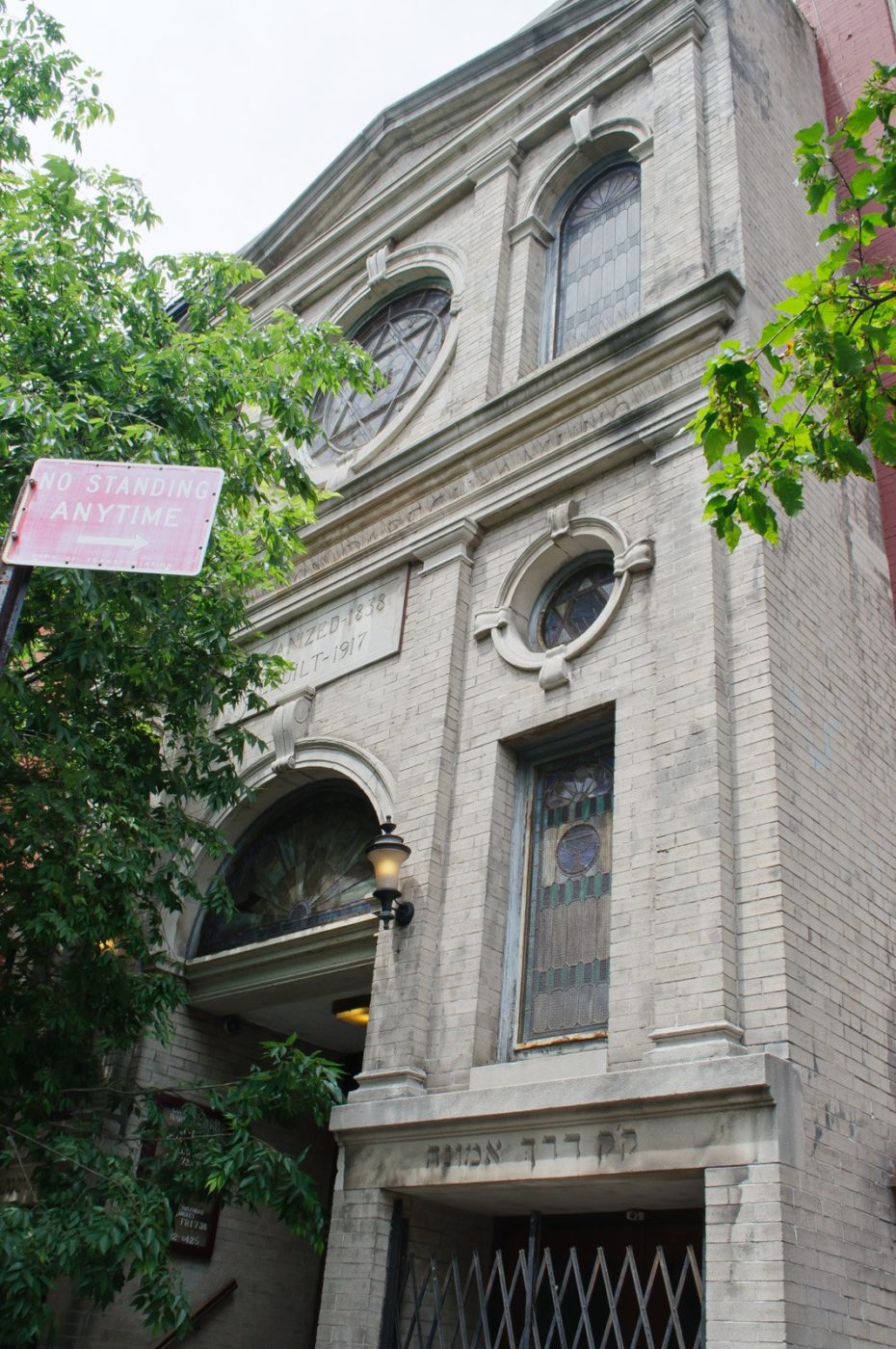
This West Village synagogue, also known as Greenwich Village Synagogue, was once a rowhouse, and was converted in 1917 with a grandly-detailed neo-Classical façade. While the building’s current incarnation is only a little over a century old, its congregation was founded in 1838, making it one of the oldest Jewish congregations in New York.
From 1866 to at least 1901, the Free Burial Fund Society, run by the congregation of Darech Amuno, buried all of the city’s Jewish poor who could not afford burials. Records indicated they took care of the burials of well over 10,000 persons during that time. In 1864 it was one of the city’s congregations which banded together to form the “Hebrew Free School” to provide free Hebrew education to children in New York City. The move was sparked by a Christian missionary organization which began offering free Hebrew education to Jewish children as a means to seek to convert them to Christianity. The first Hebrew Free School was located in a no longer extant building on Avenue C, while the second was housed by Darech Amuno in their synagogue, then located at 164 Greene Street (demolished).
Congregation Ahawath Yeshurun Shara Torah, 638 East 6th Street
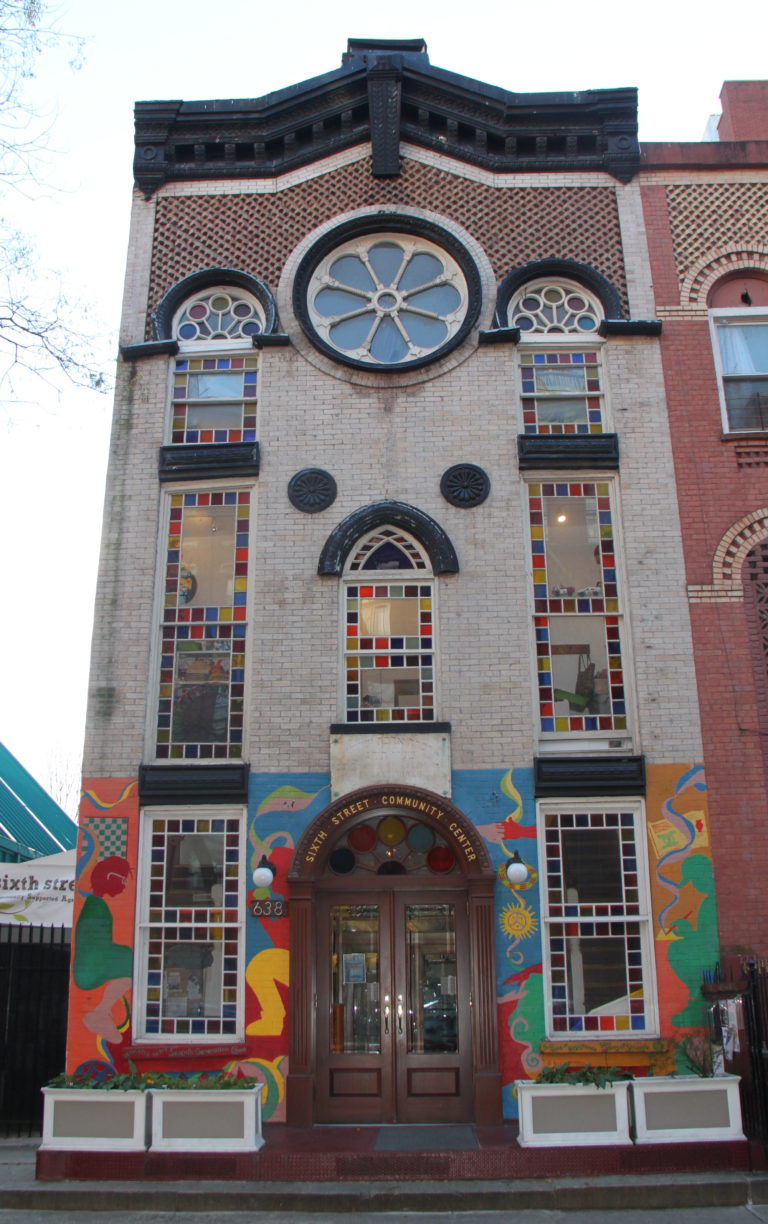
This three story, three bay, masonry structure has a symmetrical facade clad in gray brick with red brick at the top floor set at a 45 degree angle creating an interesting pattern. The parapet is peaked at the center and has a bracketed cornice. The windows are double hung with small square panes around a large center pane. There is a large rose window at the third floor flanked by horseshoe arch windows and decorative egg and dart molding around each. At the center of the second floor is a double hung window capped by a Gothic arched window and also surrounded by egg and dart molding. The round arched entry surround has a replacement door but still maintains the egg and dart molding at the top.
The first record of this building comes from an alteration permit in 1869, indicating that the building was being used as an office. In 1891, the building was converted into a synagogue for the Congregation Ahawath Yeshurun Shara Torah. In 1900, ritual baths were built in the basement, along with other alterations. The building was used as a synagogue until the 1970’s when the 6th Street Block Association, which would become the 6th Street Community Center, began to use the building. Some architectural features pointing to its past have been retained, including a Hebrew Inscription over the entry door.
Sixth Street Community Synagogue, 323-327 East 6th Street
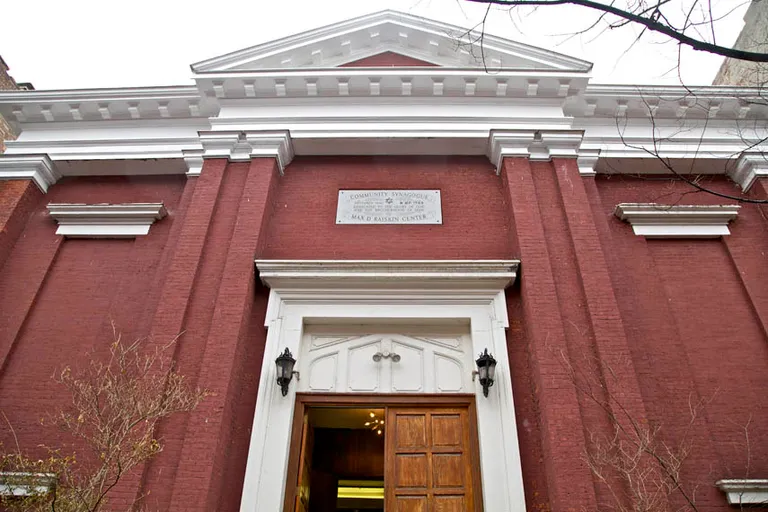
This one-story Greek Revival-style church was erected in 1847 by the German St. Matthew’s Evangelical Lutheran Church. Ten years later, the building became St. Mark’s Evangelical Lutheran Church. The church was originally constructed in response to the growing German population in the area in the 19th century. It features an entrance enframemet with a denticulated pediment, a pressed-metal cornice, molded window lintels and sills, and engaged pilasters flanking the building.
In June of 1904, the church organized a picnic for 1,300 people, mostly wives and children of German immigrant workingmen. The picnickers boarded the excursion steamer the General Slocum, and the boat departed from the East Third Street pier. As the boat moved up the river to the Long Island North Shore, a fire started in the lamp room below the main deck, setting the boat on fire and tragically killing nearly everyone on it. The building was transferred to its current owner, the Community Synagogue Center, an Orthodox congregation formed by a group led by business leader Saul Birns, in 1940. It is listed on the State and National Register of Historic Places.
Nearly 80 years later, the congregation remains vibrant and active, not only maintaining a range of Jewish cultural and religious activities but maintaining the on-site memorial to the victims of the boat fire. In 2012, it was included in the East Village/Lower East Side Historic District along with Mezritch.
To learn more about these and the many other synagogues in our neighborhoods, head to our East Village Building Blocks Synagogue tour, our Greenwich Village Historic District Jewish History Tour, our South of Union Square Jewish History Tour, and this blog post.