
From Emigrant Society to Mutual Aid: The Community Organizations Built by Immigrants
The Emigrant Industrial Savings Bank, born out of the Irish Emigrant Society, was created and opened its doors at a moment when unprecedented numbers of newcomers were arriving in New York.
The story of the Emigrant Savings Bank is about much more than banking. It is part of the larger history of how immigrant New Yorkers built institutions to help one another find work, secure housing, receive medical care, protect themselves from exploitation, maintain connections with relatives overseas, and establish a foothold in a new city.
Many of these institutions have roots in, were located in or around, and/or served the immigrant communities that lived in our neighborhoods.
The Irish Emigrant Society
The story begins with the Irish Emigrant Society, founded on March 22, 1841, with the goal of providing “advice, information, aid and protection” to Irish immigrants and promoting their welfare.
Among its founders was Dr. Robert Hogan, president of the Friendly Sons of St. Patrick, who lived with his family at 175 MacDougal Street in Greenwich Village. The Society assisted newly arrived immigrants with employment and lodging and sought to protect them from the fraudulent practices that could prey upon newcomers unfamiliar with the city. Its representatives met immigrants arriving at the port, and the organization became involved in broader efforts to improve the treatment of immigrants in New York.
The Society’s work was especially significant during and after the Irish Famine, when enormous numbers of Irish immigrants crossed the Atlantic. Its activities extended beyond immediate relief: it helped newcomers become established and maintain connections with family members who remained in Ireland.
That work led directly to the institution founded on September 30, 1850.
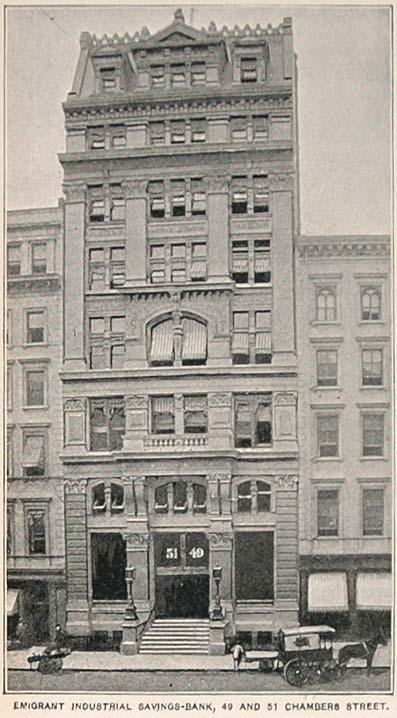
September 30, 1850: The Emigrant Savings Bank
The Emigrant Industrial Savings Bank was established by officers of the Irish Emigrant Society as an outgrowth of the Society’s concern for the welfare of Irish immigrants. Its first location was at 51 Chambers Street, just north of City Hall.
The bank offered immigrants a safe place to keep their savings and a means of sending money to relatives in Ireland. The relationship between the two organizations was unusually close. Gregory Dillon, president of the Irish Emigrant Society, became the bank’s first president, while members of the Society’s board served for decades on the bank’s board.
The bank’s surviving records reveal just how different this institution was from a conventional commercial bank. Its deposit records could include information about a depositor’s birthplace, date of arrival in America, relatives, and even the ship on which the person had crossed the Atlantic.
The first depositor was Bridget White, who opened Account No. 1 on September 30, 1850. She had arrived in New York from Ireland in 1841 aboard the Fairfield.
Today, the Emigrant Savings Bank records held by the New York Public Library constitute one of the richest sources for studying Irish immigration to New York. They contain not merely financial transactions, but fragments of individual lives and family histories.
Through the 19th century the city would be home to many immigrant banks, many of which were unofficial operations run by specific businessmen belonging to various ethnic communities, as many times these newcomers were not welcome in the traditional and established banking institutions of the city.
A Neighborhood Network of Aid
The Emigrant Savings Bank was part of a much larger network.
By the middle of the nineteenth century, immigrant New Yorkers had established organizations that addressed needs that today might be handled by government agencies, nonprofit social-service organizations, banks, employment agencies, or health-care providers.
The German Society of the City of New York, founded in 1784, had a long history of assisting German immigrants. By the nineteenth century, its activities included providing material and medical assistance, helping immigrants find employment, and meeting newcomers at the port.
Its presence was particularly relevant to what became the East Village, the center of Kleindeutschland, or Little Germany. German immigrants created an extensive institutional landscape of churches, schools, social halls, mutual-benefit societies, and benevolent organizations.
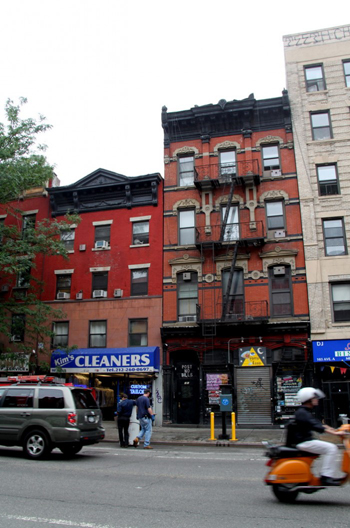
One surviving example is 101 Avenue A, where the United German Society held meetings and the Central Spar Verein maintained an office. The building’s ground-floor hall became a gathering place for German New Yorkers and a place where people could seek assistance during difficult times. After the General Slocum disaster of 1904 killed more than 1,000 people, most of them members of New York’s German community, a memorial service was held there.
Other German organizations established specialized forms of assistance, including savings institutions, hospitals, and legal-aid organizations. The result was an interconnected community infrastructure in which financial, social, religious, and charitable institutions frequently overlapped.
Children, Families, and the Poor
Immigrant aid was not limited to organizations representing particular nationalities.
The Children’s Aid Society, founded in 1853 by Charles Loring Brace, developed out of the growing recognition that poverty among New York’s children required organized intervention. Its early history was closely connected to Greenwich Village, including work associated with the Carmine Street Church, and the organization subsequently established facilities throughout the East Village.
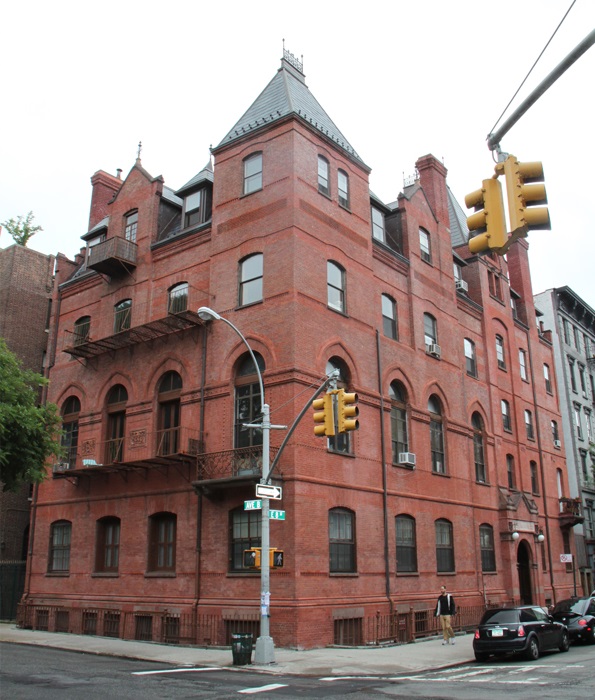
Among them were the Tompkins Square Lodging House for Boys and Industrial School and facilities for girls. Many of the children served by the organization came from immigrant families.
The Children’s Aid Society’s history was complicated. Its “placing-out” program, part of the Orphan Train Movement in the 19th century, which sent children to live and work with families outside New York, has been criticized for separating children from their families and for its Protestant and assimilationist assumptions. Nevertheless, its existence illustrates the enormous network of private social institutions that emerged in response to the poverty accompanying New York’s rapid population growth.
Mutual Aid on the Lower East Side
By the late nineteenth century, the city’s immigrant population was becoming increasingly diverse.
The Hebrew Free Loan Society, founded in 1892 by ten members of New York’s Jewish immigrant community, offered interest-free loans to people who lacked access to conventional credit. The organization began with a pooled fund of just $95.
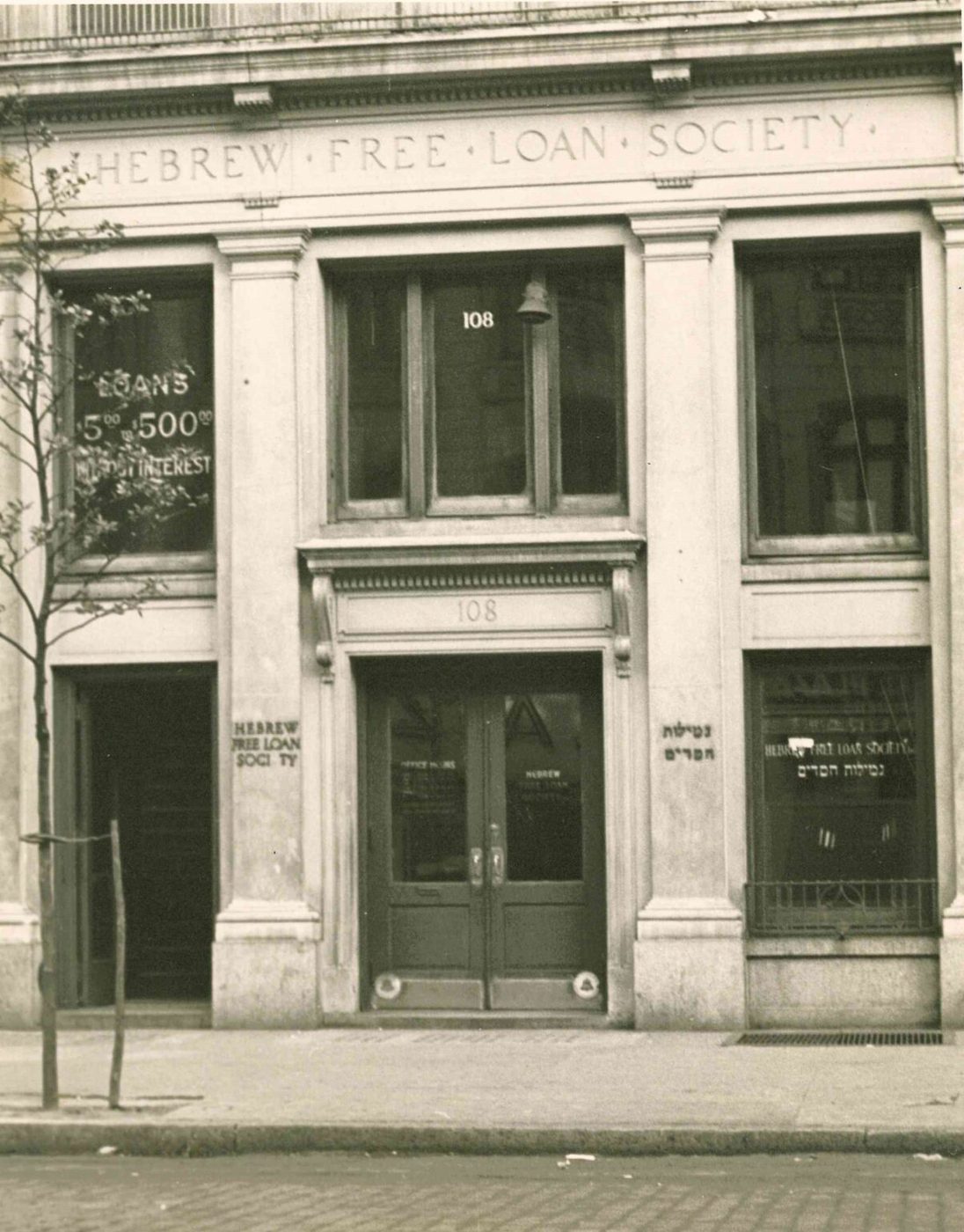
Its building at 108 East 2nd Street, constructed in 1908, became a physical expression of this philosophy. Rather than simply providing charity, the Society offered immigrants a means of borrowing money and creating greater economic stability.
This distinction is important. The Emigrant Savings Bank and the Hebrew Free Loan Society operated in very different ways, but both reflected the idea that financial security could be an essential component of immigrant independence.
Italian Immigrants and St. Raphael’s
The same pattern of community-based assistance emerged among New York’s growing Italian population. One important example was the St. Raphael’s Italian Benevolent Society, which operated a Home for Italian Immigrants at what was formerly 219 Bleecker Street in Greenwich Village.
The Society was associated with the broader Catholic network of organizations that sought to assist Italian immigrants arriving in New York. For newcomers who spoke little or no English and had few established connections in the city, an immigrant home could provide something considerably more important than a temporary bed. Such institutions could offer a first point of contact with the city, assistance finding employment and lodging, religious and social support, and protection from the difficulties that frequently confronted newly arrived immigrants.
St. Raphael’s was particularly significant because of its location. Bleecker Street was already deeply embedded in the life of Greenwich Village, while the surrounding neighborhood was increasingly home to Italian immigrants, businesses, churches, and social organizations. The Home therefore formed part of the same geographic continuum of immigrant assistance that extended from the waterfront and lower Manhattan north through Greenwich Village and into the East Village.
Its story also illustrates how immigrant aid evolved as New York’s population changed. The Irish Emigrant Society and Emigrant Savings Bank had emerged during the enormous Irish immigration of the 1840s and 1850s; German organizations became central to the East Village as Kleindeutschland developed; and by the late nineteenth and early twentieth centuries, Italian, Jewish, Austrian, Hungarian, and other immigrant communities had established their own institutions.
An “Austrian House”—or Several?
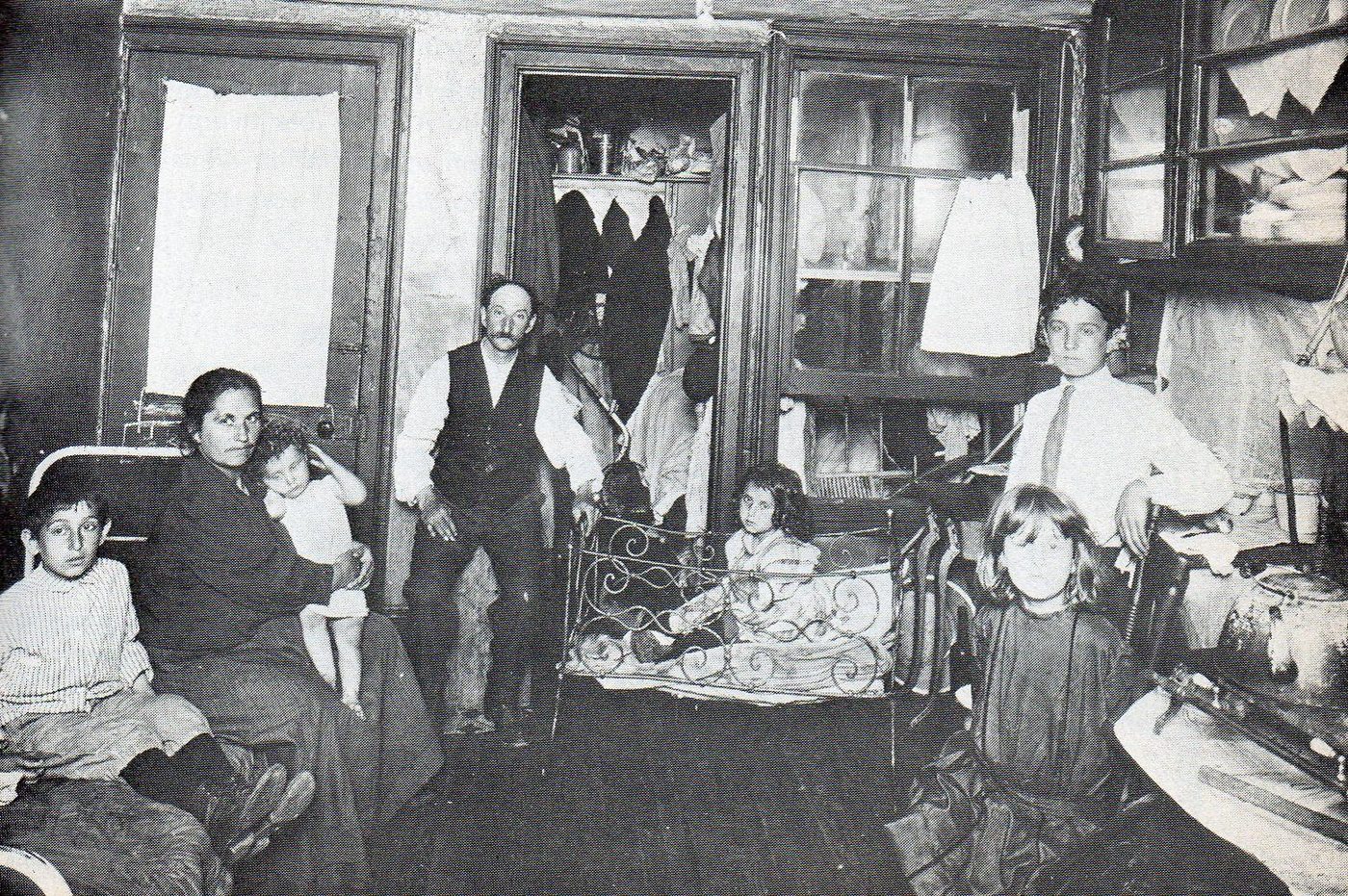
The story becomes even more intriguing when looking at what contemporary sources sometimes described more generally as an Austrian or Austro-Hungarian immigrant home.
There was, in fact, more than one such institution. Historian Kristina Poznan has documented at least three immigrant houses supported by the Austro-Hungarian government in New York during the early twentieth century: the Leo House for German-speaking migrants from the empire, the Hungarian Home for migrants from the Kingdom of Hungary, and St. Joseph’s Home for Catholic Slavic-speaking immigrants, particularly Poles from Galicia.
As immigration to the United States shifted away from northern and western Europe to the east and south, an increasing nativist attitude began to take hold. The Austro-Hungarian and Italian governments became increasing concerned about the treatment of their former citizens in the United States. These institutions reveal another dimension of immigrant aid: the governments of European countries sometimes became directly involved in the welfare of their emigrants. They sought both to protect their subjects from exploitation and to maintain connections between emigrants and their former homeland.
The Austrian Society, once located south of Canal Street at 14 Greenwich Street, was established to help immigrants find employment and provide room and board to those that needed it. Financed with a subsidy from the Austrian government of $5,000 and by donations, it assisted several thousand migrants over its lifetime.
The Hungarian Home opened in 1909 under the Hungarian Relief Society. It served migrants from the Kingdom of Hungary without regard to nationality and advertised its services in Hungarian, German, Slovene, Romanian, Serbo-Croatian, Slovak, and Ruthenian.
The Hungarian government provided substantial financial assistance. Contemporary U.S. government records reported an annual subsidy of $6,000, along with $2,000 for furnishings and equipment.
There was also the Hungarian Association of the City of New York, which had offices and facilities located at one time at 255 East 3rd Street and 156 Second Avenue in the East Village. Its funding came primarily from memberships and donations from the community.
The arrangement of these organizations could be complicated, divided between ethnic, religious, and non-religious lines. However, immigrant homes were simultaneously places of practical assistance, community-building, and—in the eyes of some contemporary observers—an extension of European governments’ efforts to influence their citizens abroad. Several of these emigrant societies would face increased scrutiny from the American government in the years leading up to the First World War.
A City Built Through Mutual Aid
By the early twentieth century, New York possessed an extraordinary constellation of organizations devoted to immigrants.
There were Irish, German, Jewish, Italian, Austrian, Hungarian, Polish, Scandinavian, and other societies. Some were explicitly charitable. Others were mutual-benefit organizations, religious institutions, employment agencies, hospitals, social clubs, or financial institutions. Many combined several of these functions.
Their geography is significant.
The institutions clustered around the southern tip of Manhattan and spread northward through Greenwich Village, the East Village, the Lower East Side, and adjacent neighborhoods. They followed the paths of immigrants themselves: from the waterfront and immigration stations into the city’s neighborhoods, workplaces, churches, boardinghouses, and homes.
The Emigrant Savings Bank was one particularly enduring and one of the oldest parts of this landscape.
Founded on September 30, 1850, it represented the transformation of immigrant aid into an institution that could help newcomers not simply survive, but accumulate savings, support relatives, and establish a more secure future. Its records preserve the names and stories of people whose experiences might otherwise have disappeared from history.
The buildings and organizations around Greenwich Village and the East Village tell the same story in different ways. From Avenue A to Bleecker Street, all represent different responses to the same fundamental challenge: how do people arriving in an unfamiliar, and not always welcoming, city and country build a community capable of helping its members survive and thrive?