
Co-Named Streets Commemorate Local Heroes, Part VIII
We’ve all seen them: signs tucked under the official names of our neighborhood streets, honoring a local luminary with a “Way,” “Place,” or “Corner.” Unfortunately, the people on these “co-named” street signs are often unknown to most passers-by. But a New York City agency has offered a way for those who are interested to get to know these local heroes and institutions a little better.
The New York City Department of Records and Information Services has assembled an interactive map to help people decipher the signs and connect with the stories behind nearly 2,500 co-named streets, intersections, parks, and other locations across the city. Our own communities feature a number of sites co-named for those who lived, worked, or created in our midst, including three that received honors in our communities over the last year. (Read about other such street honors over the past few decades here.)
Joseph Papp Way, Lafayette Street and Astor Place
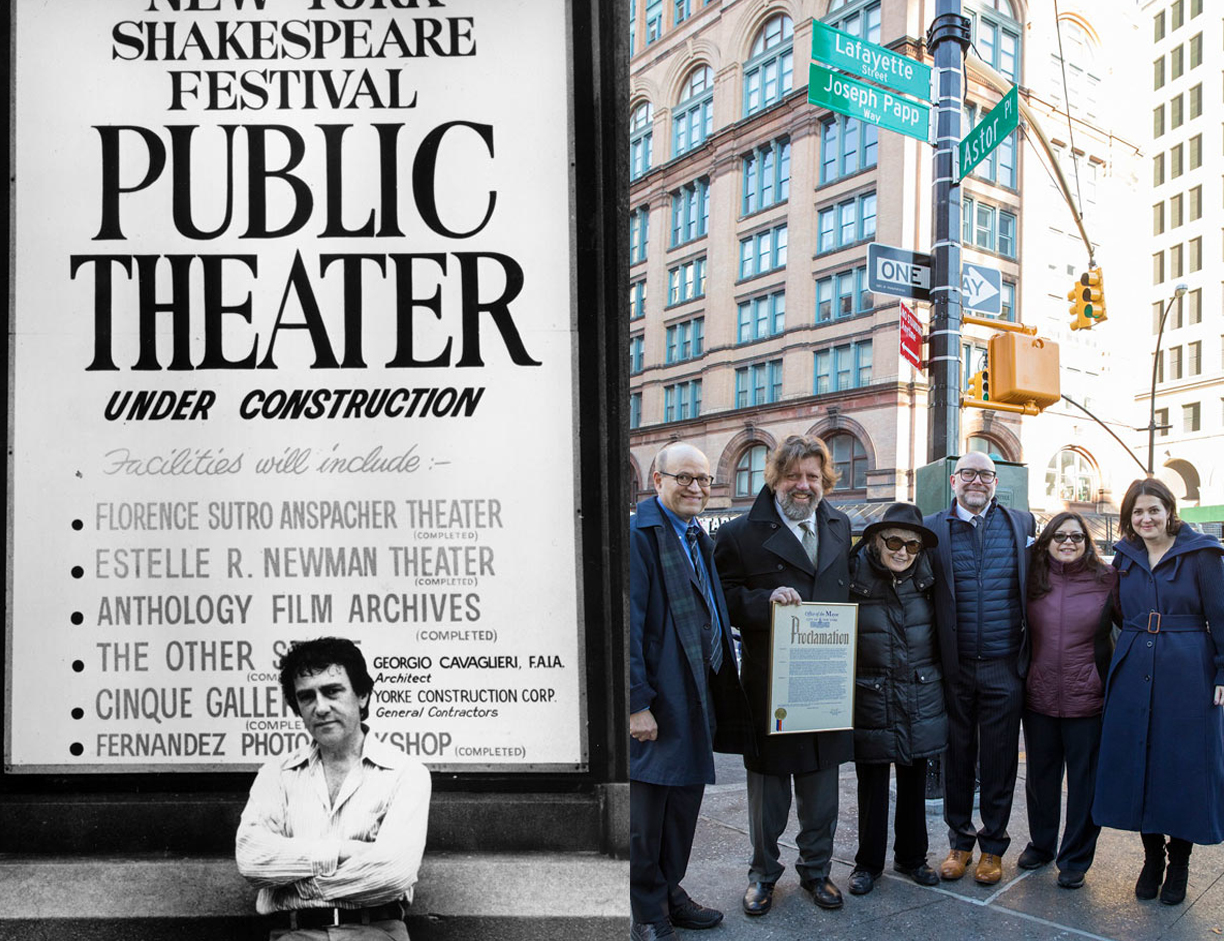
Joseph Papp (1921–1991) was one of the most influential figures in American theater, driven by the conviction that great art should be accessible to everyone regardless of class or background. In 1954, he founded the New York Shakespeare Festival, pioneering free Shakespeare performances for New Yorkers who might otherwise never have had the opportunity to experience the works. Beginning with outdoor productions in Lower Manhattan’s East River Park in 1956, Papp brought theater directly into neighborhood parks, playgrounds, and public spaces throughout the city — an effort that led to confrontations with “Power Broker” Robert Moses. In 1962, Papp established the beloved Shakespeare in the Park, still going strong to this day at Central Park’s Delacorte Theater.
Five years later, Papp established the Public Theatre in the former Astor Library at 425 Lafayette Street in NoHo. The building, originally New York City’s first free public library, faced demolition before Papp championed its preservation and transformed it into a theater. Renovated to accommodate multiple performance spaces, the Public Theater became a pioneering force in the nonprofit theater movement. Over his career, he launched more than 900 productions, profoundly reshaping American theater, including such landmark works as Hair, A Chorus Line, for colored girls who have considered suicide/when the rainbow is enuf, and Larry Kramer’s The Normal Heart. By making the Public a home for emerging voices and experimental work, accessible and representative of the city as a whole, Papp ensured that his theater would be a vital cultural institution in the East Village and New York City.
In recognition of Papp’s extraordinary contributions to New York and its cultural life, the intersection where the Public Theater stands at Lafayette Street and Astor Place was co-named Joseph Papp Way in 2017. The ceremony to install the new street signs also helped mark the Public Theatre’s 50th anniversary, honoring both the legacy of the invaluable off-Broadway institution and of the man who started it all.
Frank Crapanzano Way, Waverly Place and Charles Street
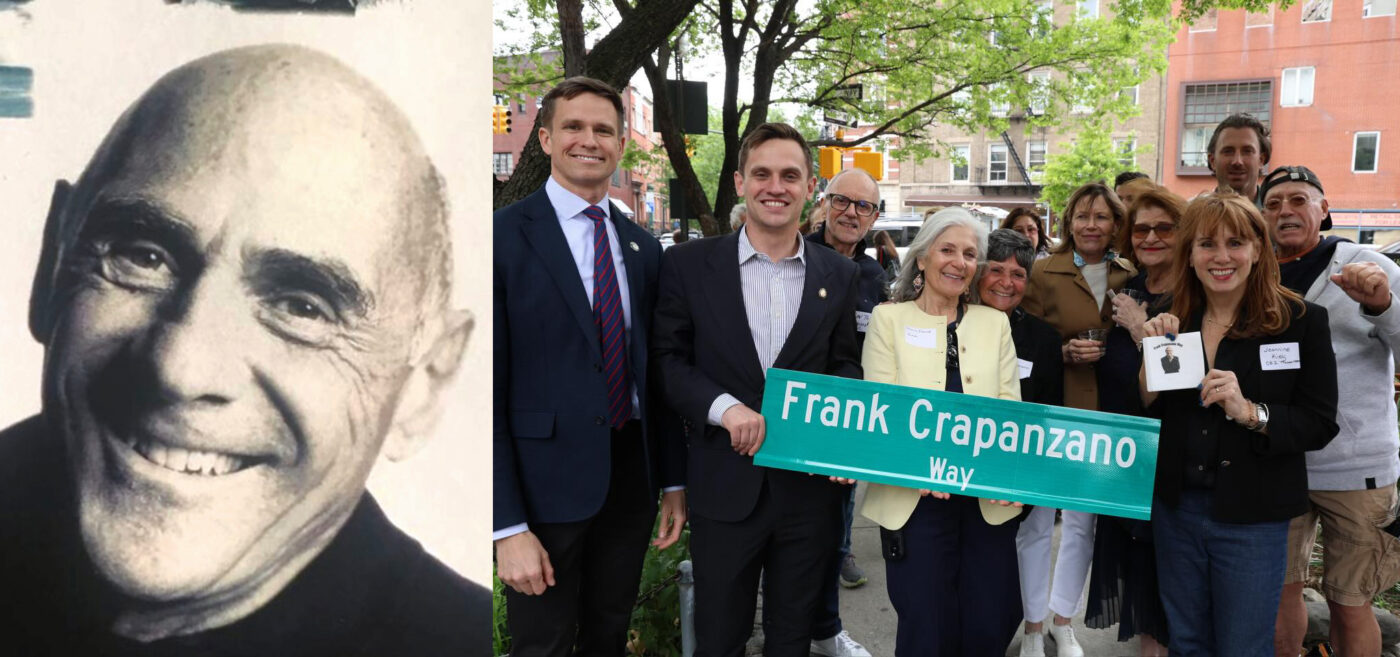
One of the city’s newest co-named streets, established earlier this year honors Frank Crapanzano, a longtime Greenwich Village resident, educator, and dedicated neighborhood volunteer whose efforts made the West Village’s McCarthy Square into an essential community oasis. Crapanzano spent 21 years in education, including serving as a guidance counselor at a South Bronx high school, and enjoyed a successful career as a print model and member of the Screen Actors Guild. He moved to 15 Charles Street in the mid-1970s, and he called it home fort almost five more decades. Following his retirement in 2006, he turned his attention to the neglected triangular park at Charles Street, Waverly Place, and Seventh Avenue South.
For more than 15 years, Crapanzano devoted countless hours to McCarthy Square, pulling weeds, planting flowers and bushes, picking up trash, raising funds from residents and local businesses, and working closely with the NYC Parks Department. His efforts made the small park a welcoming gathering place where neighbors could meet and build community. He also organized seasonal decorations and events, and helped restore the park’s World War II memorial.
After Crapanzano passed in 2021, family and friends began a campaign to co-name Waverly Place between Seventh Avenue South and Charles Street in his memory. Frank Crapanzano Way was established in 2026 at the intersection of Waverly Place and Charles Street, beside McCarthy Square. The co-naming demonstrates how one person’s sustained dedication can transform a neglected public space into a cherished neighborhood landmark.
Donald Suggs Jr. Way, Avenue B and East 6th Street
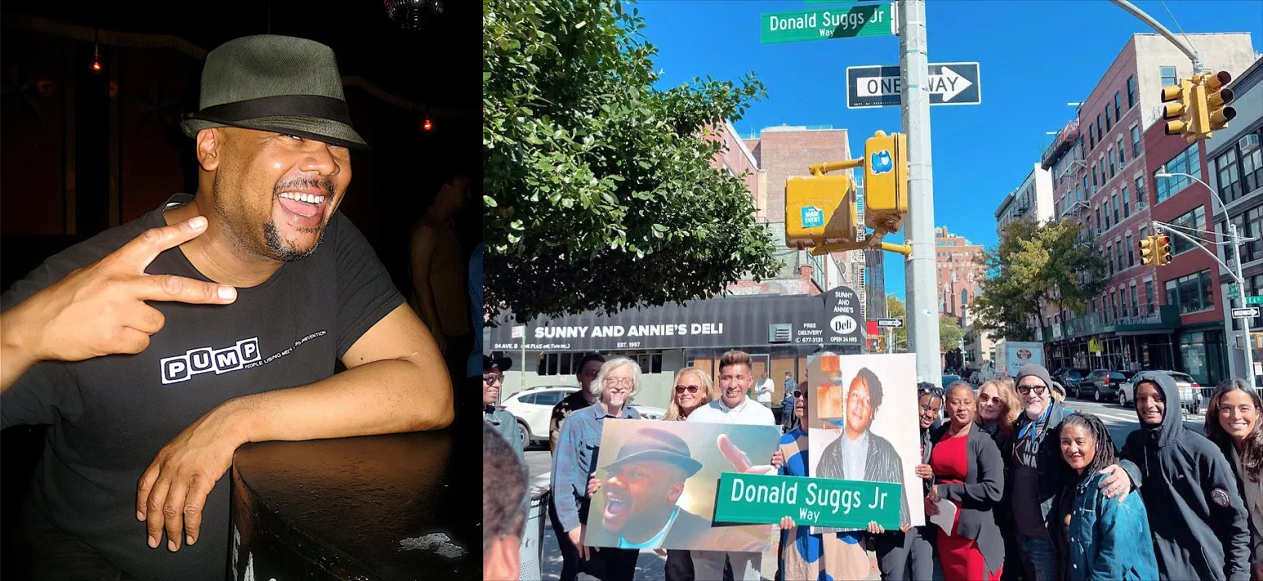
Donald Suggs Jr. was a longtime East Village resident whose activism, journalism, and artistic work left a lasting mark on the neighborhood and on LGBTQ+ and HIV/AIDS advocacy. A resident of East 6th Street, Suggs played an important role fighting for Black LGBTQ+ rights and transforming HIV prevention messaging. He served as a senior editor at The Village Voice, associate director of the Gay and Lesbian Alliance Against Defamation (GLAAD), and program director at Harlem United Community AIDS Center. His activism included organizing a campaign against homophobia in the music industry that inspired Isaac Julien’s BBC film A Darker Shade of Black.
In 1991, Suggs founded People Using Media to Do Prevention, a.k.a. the PUMP Project, which trained young people from communities heavily affected by HIV to produce their own video-based prevention campaigns. PUMP alumni later helped produce a television HIV-prevention campaign for Harlem that aired on MTV, VH1, BET, NY1, and Logo. Suggs’s work reflected his belief in the power of media to challenge prejudice, empower marginalized communities, and promote dignity and understanding.
The southwest corner of East 6th Street and Avenue B was renamed Donald Suggs Jr. Way in 2022, honoring the activist at the intersection near his longtime home. The street sign ensures that Suggs’s legacy of activism, creativity, and community-building remains visible in the neighborhood where he lived and worked.