
Noguchi, 9/11, and the Survival of Red Cube
In 1968, artist and longtime Greenwich Village resident Isamu Noguchi installed his sculpture Red Cube in front of 140 Broadway, a splash of bright crimson in an often dark skyscraper canyon of lower Manhattan. Thirty-three years later, with its brilliant hue covered in dust, the work also became a symbol of resilience and resistance for the city after the tragedy of 9/11.
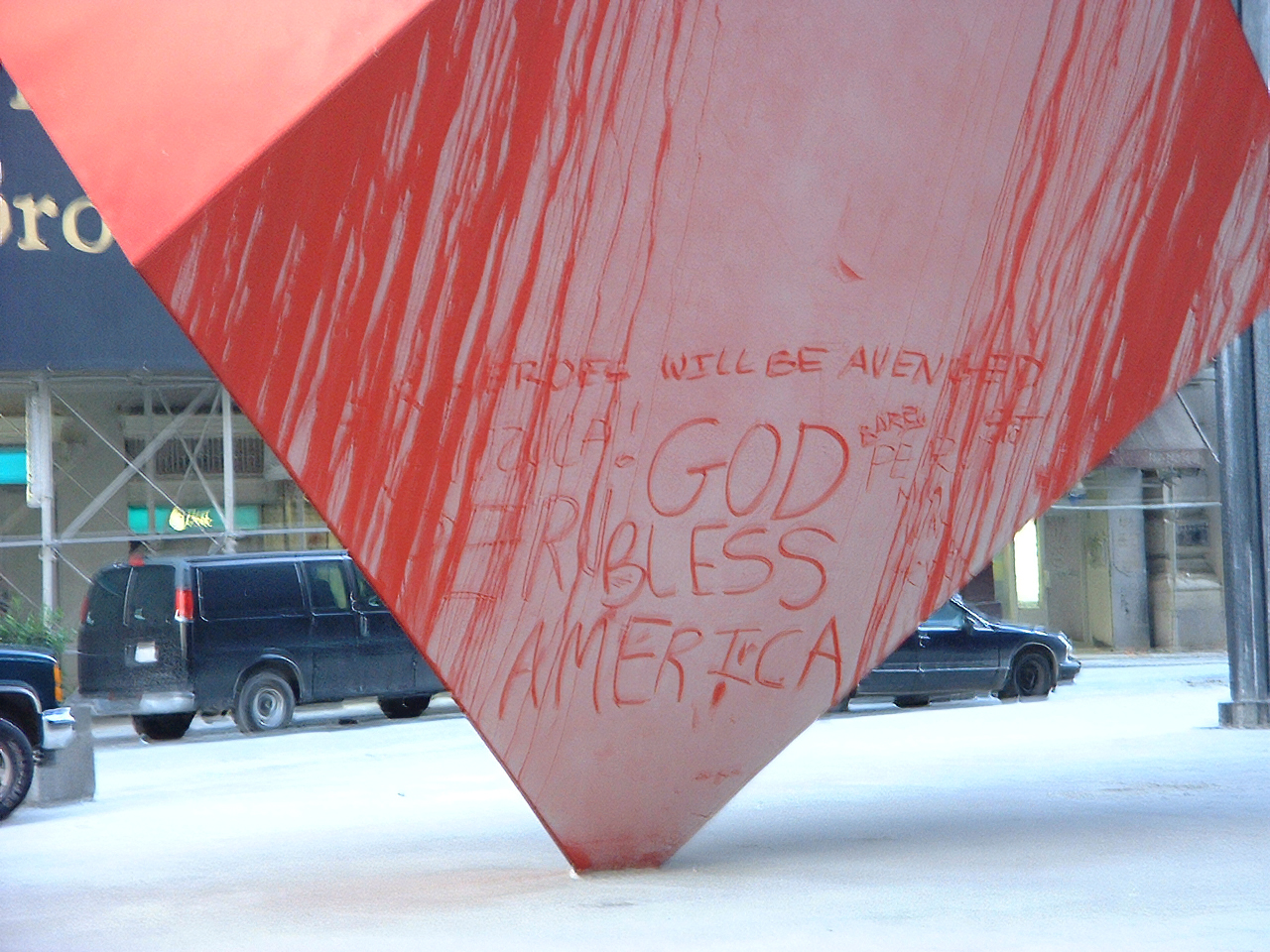
A photo of Red Cube taken by Robert Fisch on September 15, with “God Bless America” scrawled in that dust from the too-close Word Trade Center towers, is one of many images featured in Village Preservation’s latest StoryMap, “The World Trade Center, 9/11, and Its Aftermath through our Historic Image Archive.” The curated tour highlights key moments in and around our neighborhoods before, during, and after that tragic day, culled from 10 collections among the dozens in our historic image archive.
Noguchi’s sculpture is one of the city’s first efforts to integrate major works of modern art into New York City’s commercial and public spaces. The 28-ft.-high steel cube, weighing approximately 24 tons, is turned on its axis so that one corner always points toward the ground and another toward the sky. The shifting frame created by the cylindrical hole at center constantly alters how the piece is perceived as vistors move around it and how the surrounding city can be viewed through it. The sculpture’s geometry echoes the towering rectilinear architecture of Lower Manhattan; its brilliant red surface sets it apart from the gray and black buildings around it, notably fellow one-time Villager Gordon Bunshaft’s landmarked Marine Midland Bank (1968) in whose plaza the cube sits. “A sculptor,” Noguchi noted, “is not merely a decorator of buildings but a serious collaborator with the architect in the creation of significant space and of significant shapes which define this space.”
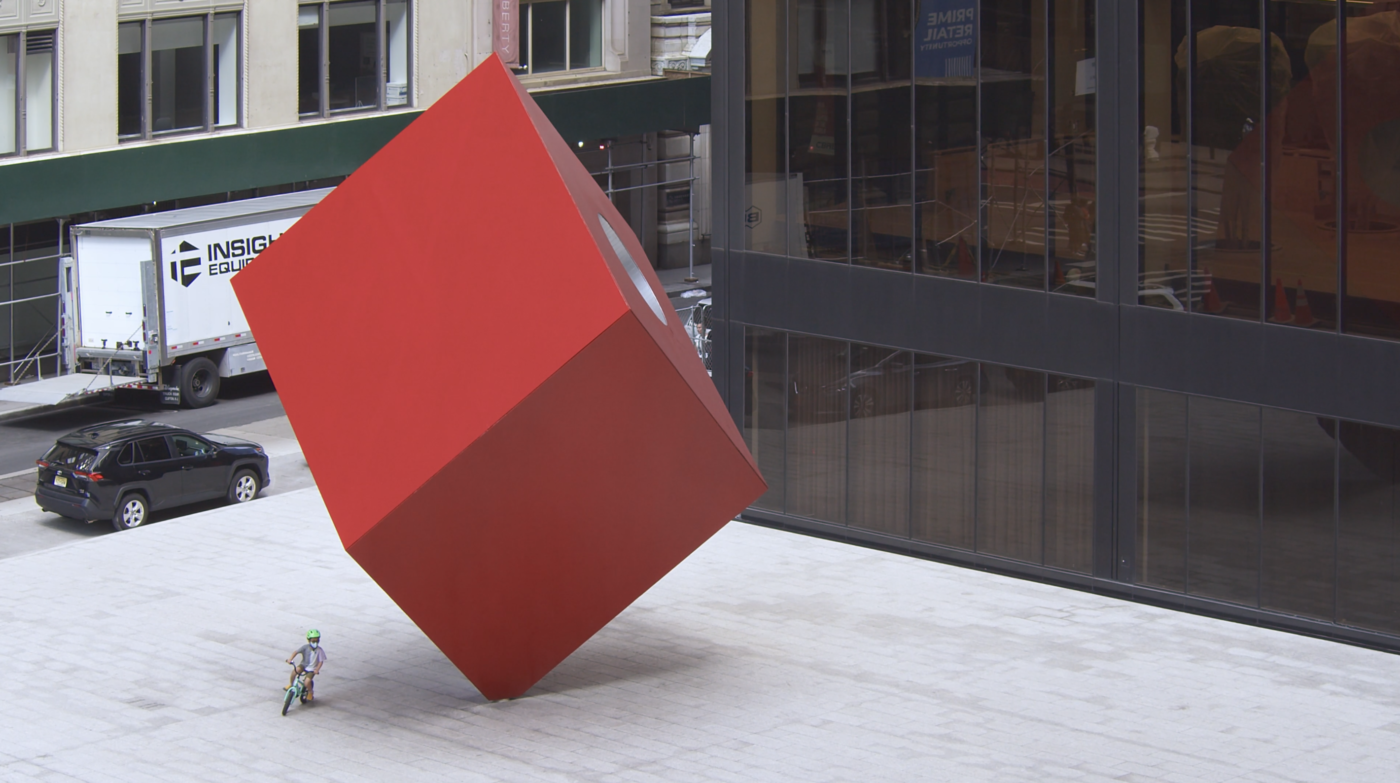
The terrorist attacks of September 11, 2001, altered the public’s view of Red Cube. Located only a few blocks from the World Trade Center, the sculpture remained standing amid a devastated Lower Manhattan. In the aftermath of the attacks, the familiar work became part of a landscape marked by loss, destruction, recovery, and resilience. Its survival gave the sculpture a new symbolic resonance, particularly because the circular opening through its center could evoke both absence and continuation: an empty space incorporated into a solid, monumental form. The meaning of Red Cube, like that of much public art, was reshaped by history: What Noguchi created as an abstract intervention in an urban plaza came to be experienced, after 9/11, within the larger story of Lower Manhattan’s endurance and recovery.

Noguchi (1904–1988) was one of the 20th century’s most inventive and wide-ranging artists. Resisting easy creative classification, he was a sculptor, designer, landscape architect, set designer, and creator of objects from monumental public artworks to furniture and lamps. He believed that sculpture should not simply be an isolated object on a pedestal, but could shape and activate the world around it. His work on Red Cube and other major public commissions repeatedly explored the relationship between solid form and empty space, art and architecture, and the individual object and the larger landscape.
Noguchi’s work brought him to Greenwich Village for a significant part of his career, one that he voluntarily interrupted in 1942 when he joined fellow Japanese Americans in internment during World War II. He was living at 52 West 10th Street when his artistic career began to take off in 1940 with the installation of News, his large stainless-steel bas relief for the Associated Press Building in Rockefeller Center. Upon his return from the Poston War Relocation Center in Arizona, Noguchi set up a home studio in 33 MacDougal Alley, where he lived for much of the 1940s, creating some of his most enduring sculptures.
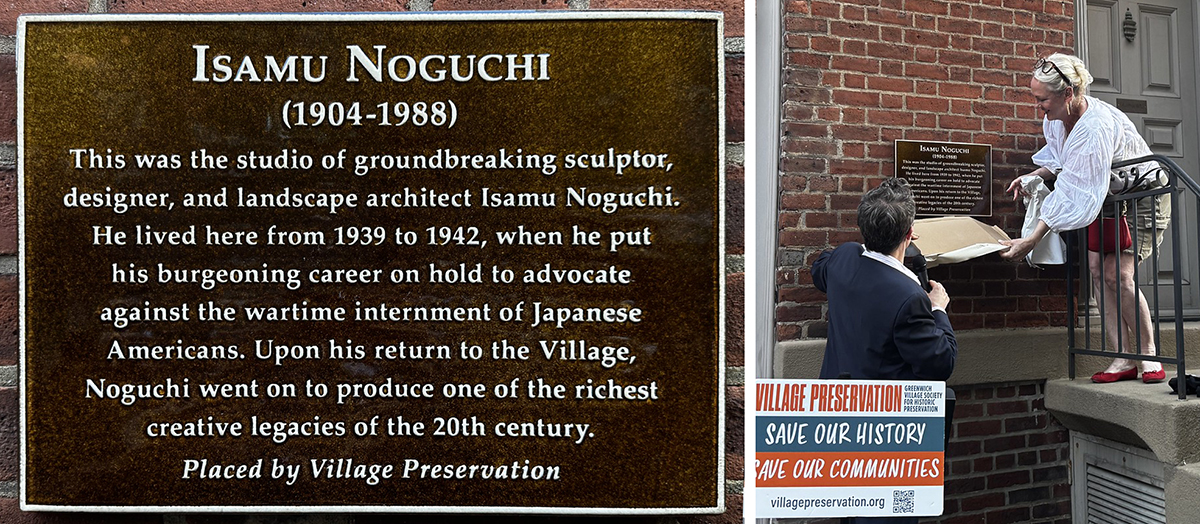
On April 16, 2026, Village Preservation honored his achievements and artistic insight with our 28th historic plaque. Installed outside his former West 10th studio, the plaque honors “one of the richest creative legacies of the 20th century.”
That legacy is exemplified by the bright red sculpture on lower Broadway, a lasting testament to Noguchi’s belief that sculpture could fundamentally transform the spaces in which people live and move. Before September 11, the work was one of Lower Manhattan’s most distinctive sights, a bold interruption of the Financial District’s rigid geometry, and a modern sculpture that became part of everyday urban life. After 9/11, its survival just blocks from Ground Zero gave the familiar sculpture an added resonance in a city confronting an unimaginable absence. One of Noguchi’s most recognizable public works, Red Cube is a powerful expression of artistic vision whose meaning has continued to evolve with the city around it.
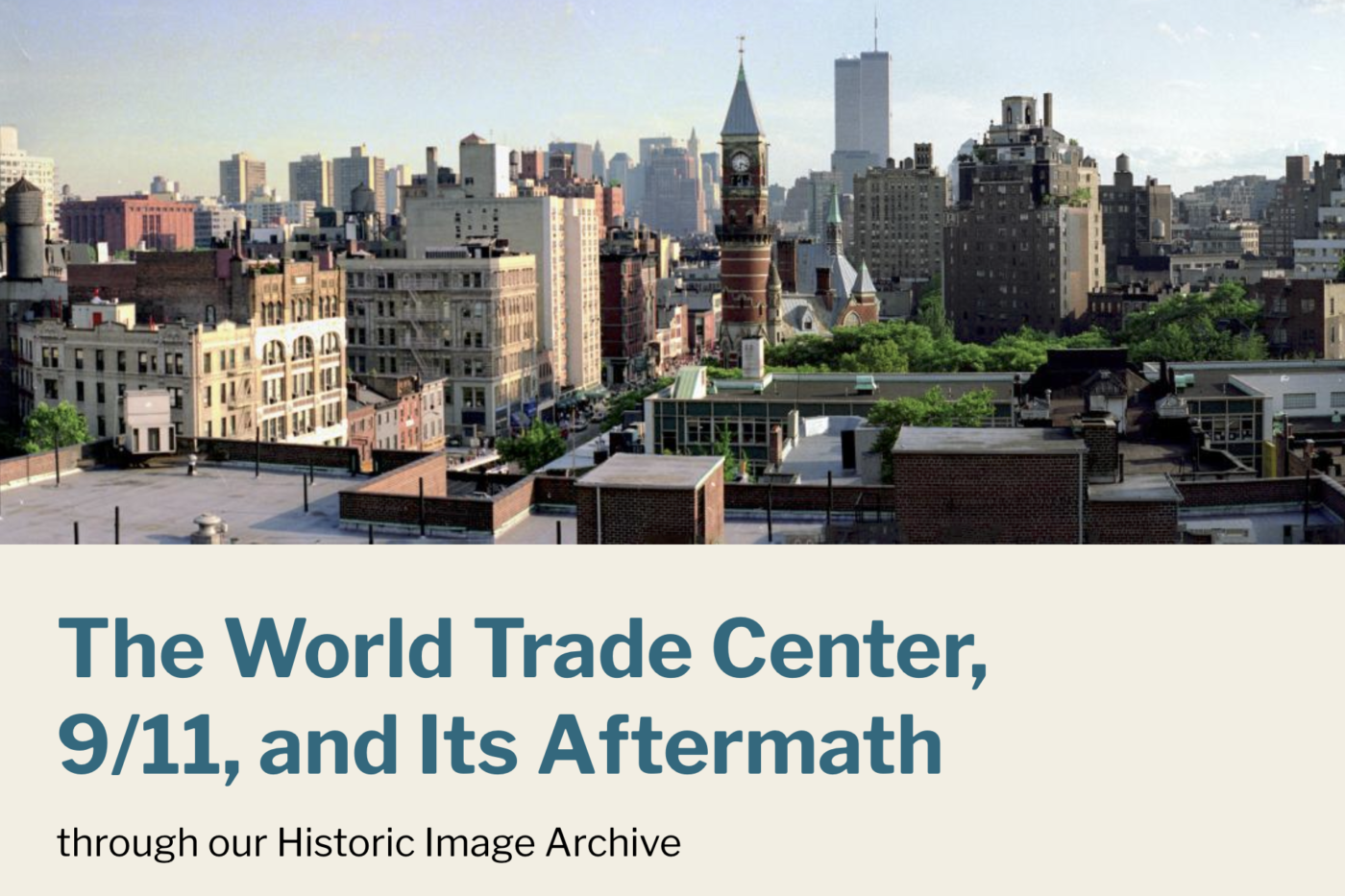
Explore all of “The World Trade Center, 9/11, and Its Aftermath through our Historic Image Archive” here and all of our map resources here. Learn more about Noguchi’s life here, the historic plaque here, and all of our plaques here.